Toyota is turning old cars into new ones – we visited the factory to find out more
A behind the scenes look at the manufacturing and recycling facilities in Toyota’s Circular Factory

Words by: Erin Baker
Published on 12 June 2026 | 0 min read
Should drivers know what goes on at a car factory, to make more ethical and greener choices about what they drive? The fashion world would suggest the answer is yes: we now want to know if the jeans we’re wearing were made in an Indian sweatshop by children, and whether the pre-distressing meant using loads of water and harmful dye. So, too, the supermarket experience: shoppers are heading away from intensively reared battery chickens, lice-infested salmon farms, avocadoes that have used a nation’s supply of water to grow them and blueberries that have been flown over from Chile in November because we fancy them on our yoghurt.
Big factories can be boring, difficult places in which to understand what’s actually going on however, with complicated manufacturing processes that seem a world away from the fancy-pants car on your driveway. To give you an idea of how mind-boggling they are, the Toyota factory in Derbyshire that we toured recently, which is their first European Circular Factory, churns out one Corolla every 141 seconds.
It’s massive, fast, complicated and bewildering. We spent a day there, speaking to the experts, walking up and down the production lines, touring the recycling and re-use sites, to understand what they are doing to cut down waste, energy usage, raw-materials usage and emissions, so we can give you the kind of insight that could be helpful when you’re browsing Autotrader for your next car, because every brand is now trying to create the sort of circular-economy factory we toured.

Let’s start with what a car manufacturing plant (a plant is a collection of factories) has historically always done: receive materials and parts, and use them to build new vehicles. Nowadays, that’s not good enough: the planet has limited resources for new parts. So every brand is looking at how to re-use, re-purpose or recycle entire cars, their parts and raw materials, to feed it all back into the manufacturing process.
Most brands, like Toyota, are creating new areas in their factories to do all this, because the people, skills and space are already there. It’s a weird business though: while the production lines keep churning out new cars in a well-practised ballet of machines, robots and movement, in other warehouses around this main plant, people are scratching their heads, trialling and experimenting, and generally working it out as they go along. It’s crazy to see this new industry in its infancy (because it will become just that – a huge global industry and revenue-raiser for these businesses – “eliminating waste is a business opportunity”, as Leon van der Merwe, Toyota’s European vice president, told me.) Dare we say it, it’s pretty exciting.

So what’s the deal?
First up, here’s the circular-factory idea:
- Design cars for circularity in the first place (fewer, easily accessible parts that can be removed without damage; recyclable materials; identified materials; no tricky coatings. Otherwise, the cost of recycled parts will be more expensive than virgin ones and it won’t work as a business model)
- Reduce the waste from producing cars and exporting/transporting them
- Extend the life of the vehicle (through refurbishing and remanufacturing them and promoting car-share schemes because average car usage per owner is less than one hour a day, so we need to get more use out of them)
- Sort out what happens at the end of the car’s life (can their parts be used elsewhere, or how do we best recycle them?)
- Repurpose parts (into something other than cars)
- Take the recycled material and reintegrate it back into this journey as new parts at point 2, as part of the waste-reduction point


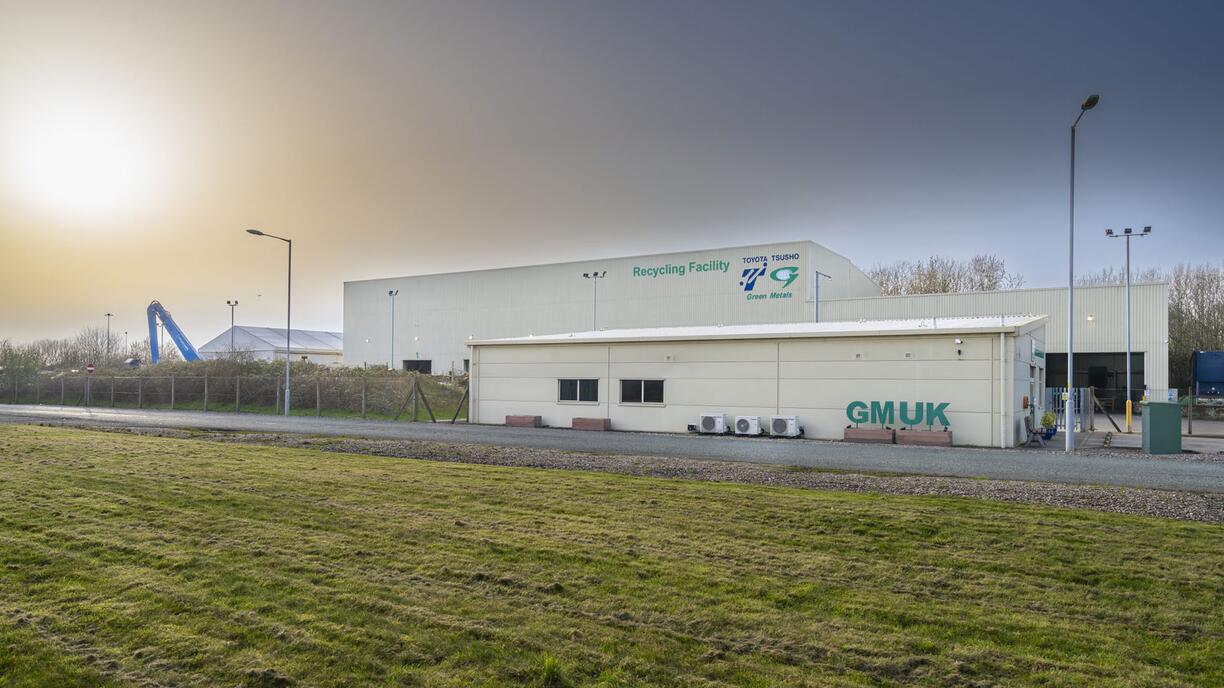
So what’s the process for dismantling, reusing and recycling a car and its parts in the Derbyshire plant? First, it’s important to note that Toyota is currently not only recycling old Toyotas, but all sorts of end-of-life cars, sourced locally via insurers, because no factory has a big enough source of its own end-of-life vehicles (ELVs) yet. We scanned a little graveyard of sad old Saabs, Vauxhalls, Fords and more, each battered and rusting, but still with sweet wrappers, tissues and other fragments of memories blown by the breeze around their forlorn interiors.
Toyota takes a car inside, blows up its airbags, drains it of fluids and gases and dismantles the car, sorting electrical copper wiring, brake discs, catalytic converters, aluminium, entire engines, plastic dashboards and so on into giant bins. This sorting not only makes the next stage of re-use and re-integration back into the manufacturing chain quicker and easier, but it gives employees the chance to learn about how materials behave, their durability and how easy they are to access in the dismantling phase.
The whole thing is simultaneously a slick business in action and a classroom full of learning. The aim is to dismantle an entire car in under three hours, to process 10,000 cars a year and to bring new life to 120,000 parts.

With the car fully stripped down to its metal skeleton, it is shunted outside, picked up by a grabber and chucked into a spectacular crushing machine that is silent (for the benefit of neighbours) and swift, reducing the car to a metal cube in two minutes. It’s freaky and very satisfying.
The resulting cube is then sold to commodity traders, as is the copper wiring, steel, aluminium, plastics and the remanufactured parts (Toyota’s own are sold to retailers, while multi-brand parts are sold to parts traders), and thus the profit pools start to form, which are further enhanced by all the materials and parts that feed straight back into Toyota’s supply chain. And boy, do we need it to be profitable, otherwise car companies will just keep digging this stuff out of the ground because it’s cheaper to mine and extract from the earth.

Add into this mix the solar panels by the front door which currently supply a measly five per cent of the plant’s energy but should supply 20 per cent by the rest of the year, and you start to see the pace of this upward trajectory in green manufacturing.
It’s exciting, because it feels like optimism is in the air, and the world is in short supply of that right now. The car industry is playing a big part – admittedly a little late in the day – in trying to reduce the impact of road transport in climate change, and wean us off fossil fuels and raw virgin materials. Drivers who can, should vote with their wallets, while the rest of us at least lean in to discover what’s possible, and which brands are making a concerted effort to change.
