Ford E-Transit Courier vs Kia PV5 Cargo
The Kia PV5 Cargo and Ford E-Transit Courier go up against each other in a small electric van tussle for the ages

Words by: Tom Roberts
Published on 21 July 2026 | 0 min read
Small electric vans have had a spotlight thrown on them by the launch of the Kia PV5 Cargo. One day Kia rolled the dice and developed a van that has made all of the major manufacturers nervously look over their shoulders. That dice roll has definitely paid off, which is why I wanted to pit it against something comparable in price and stats… and one from a big name (perhaps the biggest in light commercial vehicles).
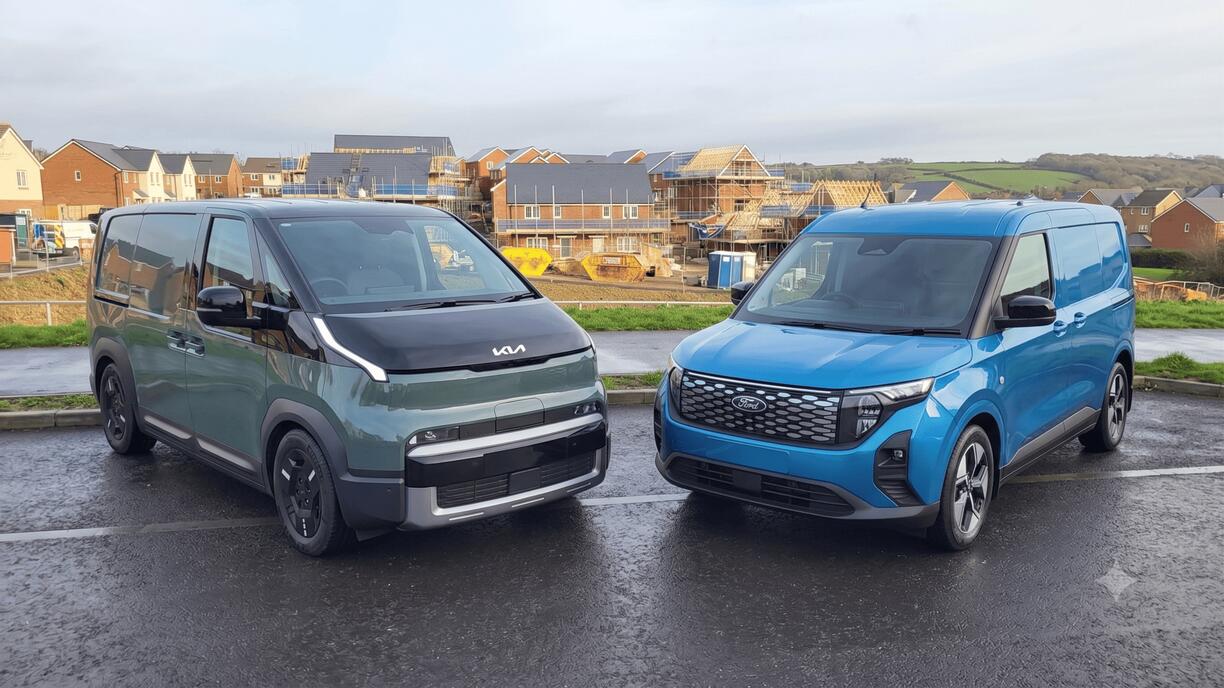
So, here we are, the Kia PV5 Cargo versus the Ford E-Transit Courier. Two vans I really rate, from two companies I think make great vans. This won’t be tricky at all! The best place to start is to take a snapshot look at the headline stats, and to keep it fair I’ve opted for the smallest PV5 Cargo and the standard E-Transit Courier, which only comes in one size.


Feature | Kia PV5 Cargo L1H1 | Ford E-Transit Courier L1H1 |
Powertrain | Electric | Electric |
Price (ev VAT) | Around £28K | Around £28K |
Load volume | 4.0 cubic metres | 2.9-3.1 cubic metres |
Max payload | Up to 790 kg | Up to 700 kg |
Warranty | Seven years / 100,000 miles, eight-year battery warranty | Three years / 60,000 miles, eight-year battery warranty |
Cargo and practicality
The L1H1 version of the PV5 Cargo provides four cubic metres of load volume, just a bit bigger than the VW ID.Buzz Cargo. It has a low 42-cm load lip, more than enough tie-down points, ceiling lights, and 50/50 split rear doors with a single passenger-side sliding door. However, it has noticeable quirks including a narrow 92-cm load floor trough at the rear opening that restricts pallet loading, the side doors aren’t wide enough to take a pallet, and a rear door latch housing in the top of the rear opening I bumped my head on more times that I care to remember.
On the other hand, and despite its compact footprint, the E-Transit Courier manages to provide 2.9 cubic metres of load volume, 60/40 rear doors, a sliding side door, and enough floor width to take two Euro pallets lengthways (1.8 m load length) with no floor troughs getting in the way. Notable practical highlights include an optional bulkhead load-through hatch (extending load length to 2.6 metres) and a frunk. It’s smaller than the PV5 Cargo in the back, but it definitely makes better use of the space.


Interior tech and comfort
The PV5 Cargo features a modern, hard-wearing interior with generous storage cubbies. Technology is strong, best demonstrated by the seven-inch digital driver display and 12.9-inch central touch-screen with Apple CarPlay and Android Auto. Essential trim comes standard with air con and other essentials, while Plus trim adds luxury touches like heated front seats, a heated leather steering wheel and wireless phone charging. The driver’s visibility is only slightly impaired by wide double A-pillars, but it really is a smashing cabin… although one that really needed more armrests at launch.
The Ford E-Transit Courier’s interior, meanwhile, definitely has the feel it was designed to provide a more functional, classic commercial feel. It makes extensive use of durable textured plastics, though it includes features like an upper roof shelf, central storage dividers, and a flat-topped, flat-bottomed ‘squircle’ steering wheel. Tech highlights include a digital driver’s cluster, a 12-inch Sync4 infotainment touch-screen, wireless phone charging, and keyless start. Higher trims add a heated windscreen and steering wheel, but taller drivers should be aware of the exposed seat rails catching clothing when sliding back.


Ride, handling and performance
The PV5 Cargo is powered by a choice of two batteries (51.5 kWh for 184 miles of range or 71.2 kWh for around 260 miles. It’s a responsive drive with controlled acceleration and… yeah, you know Kia can make good electric cars so it makes sense their electric van drives well. Its front wishbone suspension also does a good job of soaking up rough roads without too much harsh lurching. While unladen it does roll in tight corners, but adding any sort of load settles things down significantly. It’s a confident drive, for sure.
And the Ford E-Transit Courier fares about the same. Built on the Ford Puma passenger car platform, it delivers a smooth, quiet, car-like driving experience with quite a bit of power at your foot tips. The pleasingly stiff suspension handles the weight of the battery pack well, making it feel planted to the road even before I added a 250 kg test payload. Thanks to its diminutive size and car platform, it easily maneuvers through tight urban environments, maintains its poise on motorways, and offers up to 182 miles of range.


Safety and security
Achieving a five-star Euro NCAP rating, the PV5 provides a good level of standard safety features including collision detection/avoidance, lane keep assist, cruise control, driving assist, speed limiter, front and rear parking sensors, a reversing camera, and an alarm system. The Plus trim level adds blind-spot assist, rear cross-traffic protection, and safe exit warnings. And it’s not one of those vans that makes a lot of noise at you.
The Ford E-Transit Courier also bagged a platinum Euro NCAP rating, and is well equipped with standard driver aids including cruise control, wrong-way assist, lane assist, traffic sign recognition, roll stability control, alertness monitoring, and traction control. Optional extras allow potential buyers to add adaptive cruise control, blind-spot monitoring, rear cross-traffic alert, and a digital rear-view mirror camera feed. It too keeps things simple and doesn’t bark at you all the time.


The verdict

