Dacia Spring Cargo vs Citroen e-C3 Van
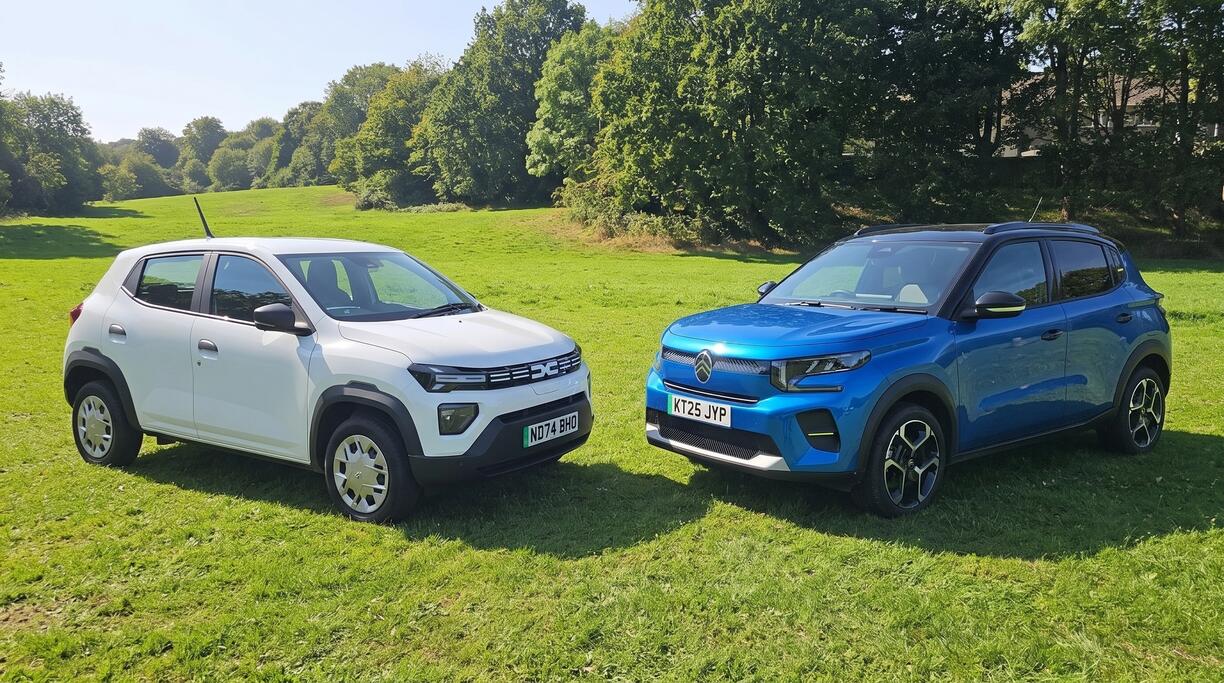
Two light car-derived electric vans – the Dacia Spring Cargo and Citroen e-C3 Van – go head to head in this ultra-lightweight royal rumble

Words by: Tom Roberts
Published on 14 October 2026 | 0 min read
In late 2025 it felt like every manufacturer was finding a small car in their lineup and turning it into a van. They all followed the same process: pick car, strip out back seats, level off boot space into back seat space, slap blackout film on the rear glass, insert bulkhead behind front seats. It’s a time-honoured recipe for really any van that starts life as a car, and both the Dacia Spring Cargo and Citroen e-C3 Van follow it to the letter.
The idea is that an electric van as small as these give business owners the chance to run a (relatively) low-cost, zero-emission in the cause of greener business driving. And fair play to that! Here’s a quick side-by-side comparison table for you to see some key stats:
Category | Dacia Spring Cargo | Citroen e-C3 Van |
Powertrain | Electric, 26.8 kWh battery provides ~140-mile range | Electric, 44 kWh battery provides ~200-mile range |
Starting price (ex VAT) | ~£16K | ~£17K |
Load volume | ~1.0 cubic metres | ~1.2 cubic metres |
Maximum payload | 370 kg | 300 kg |
Warranty length | Three years / 60,000 miles, and the battery is covered for eight years / 75,000 miles | Three years / 60,000 miles, and the battery is covered for eight years / 100,000 miles |
Cargo and practicality
You know the old saying? “Tell people what you want to tell them, tell them again, then tell them what you told them.” So I will. Both vans have undergone (pretty much) the same conversion: rear seats are binned, a levelled floor is created, lashing points are installed, and a metal bulkhead inserted between the front seats and the cargo space. And from that, we’ll get into the vehicles themselves.
The Dacia Spring Cargo can carry up to one cubic metre of load volume up to a maximum weight of 370 kg… which is more than the Citroen. Loading is simple via the boot hatch or blacked out side doors, and being a tiny car makes tight parking a breeze. However, visibility is brutally (no, I’m not being dramatic) compromised by the blacked-out glass, tiny side mirrors, small door mirrors, and a tiny aperture in the rear hatch. It’s terrifying to drive at night… you have to rely on headlights around you to place where other vehicles are.
Meanwhile, the Citroen e-C3 Van can carry load volumes of over 1.2 cubic metres (unless you put the load cover in place which takes that down to 0.7 cubic metres. So, you get more room than in the Dacia AND it can only carry 300 kg of weight. Reversing visibility is restricted due to the dark film on the side door windows and bulkhead, but the mirrors and rear window aperture are far bigger to compensate.


Interior tech and comfort
The Dacia Spring Cargo has what I’d call an ‘is what it is’ cabin. You get comfortable front seats (with no height adjustment), durable plastics, and a 10-inch infotainment touch-screen featuring Apple CarPlay and Android Auto. You get actual physical buttons to deal with climate controls. Storage space (and general space) is limited, but cubbies and USB ports are plentiful enough.
And as for the Citroen e-C3 Van, well, it delivers a more ‘modern’ environment with softer, more squashy seats. It also has a 10-inch main touch-screen and physical climate controls, but instead of a full-size driver display behind the steering wheel is a narrow strip screen above its tiny steering wheel. This screen is notoriously frustrating to customise, but it does little to dampen a far more roomy cabin than the Dacia’s.


Ride, handling and performance
Anyone snapping up a Dacia Spring Cargo needs to know its built for urban environments and short town runs. It has a small battery (26.8 kWh) providing an official 140-mile range although that’s more like 120 miles real-world. Power disappears quickly when you need it (not good) and light steering creates body roll in corners (which feels chaotic in a small vehicle). However, regenerative braking is effective and rapid charging from 20 to 80 per cent takes around 45 minutes as the smaller battery throttles charging speeds quicker than the Citroen.
The Citroen e-C3 Van packs a larger battery for a solid 200-mile range (180 real-world miles). It’s nippy around town, but wind noise is very noticeable above 50 mph. City streets and country lanes are handled well and the van feels far more planted to the ground than the Dacia. Rapid charging at 100 kW will get the battery from 20 to 80 per cent in just 26 minutes. If it sounds like I prefer this van’s driving manners to the other, it’s because I do.


Safety and security
Being based on the Spring, Dacia’s van scores a dismal one-star Euro NCAP safety rating. You get airbags, emergency braking, speed assist, and traffic sign recognition, but its light weight makes you feel like you're sitting in a flimsy tin box. The poor visibility from the tiny door mirrors and blacked-out glass in the side doors creates a sense of isolation I don’t enjoy. On the plus side, it does include front and rear parking sensors and a reversing camera.
Citroen’s van has not been rated by NCAP, but feels noticeably heavier and more planted on the road, which is reassuring. Security systems include standard braking and stability controls, lane departure warning and airbags. Perhaps its standout safety feature is the e-Call system, which automatically contacts emergency services if an airbag deploys. Rear parking sensors are standard, though the lack of a reversing camera is an odd exclusion.


Verdict

