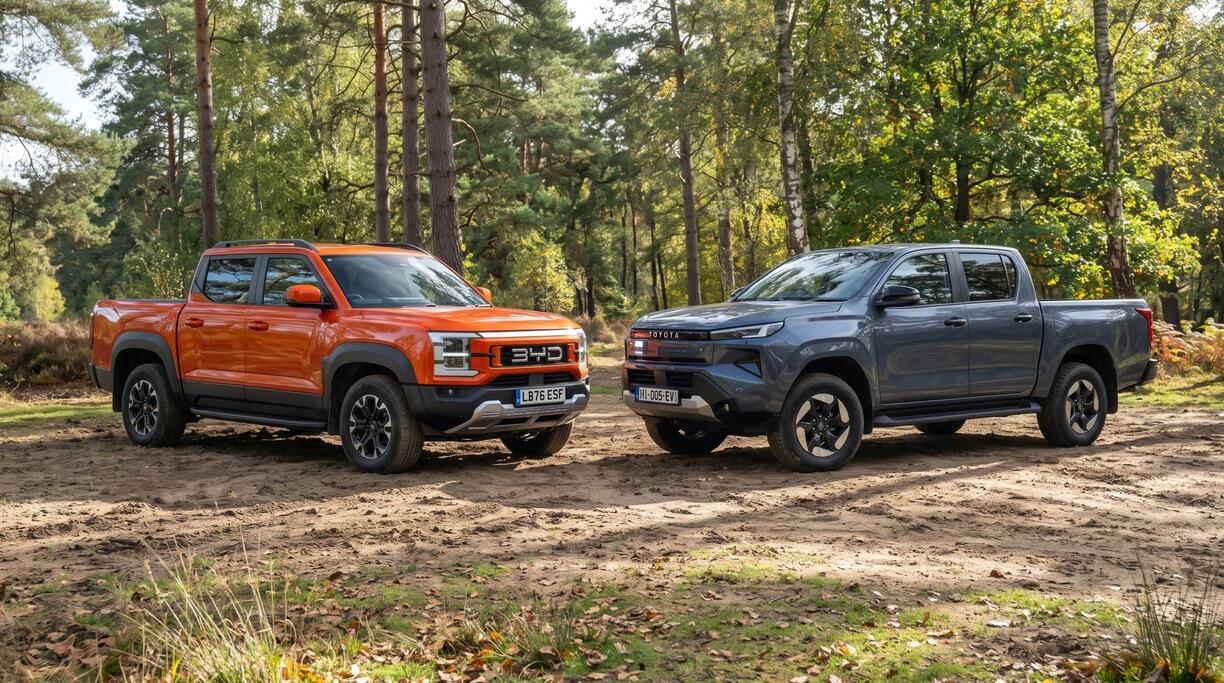
Toyota Hilux BEV vs BYD Shark
Two new pick-up trucks go head-to-head in the latest comparison article – let’s see if the Toyota Hilux BEV or BYD Shark comes out on top

Words by: Tom Roberts
Published on 28 October 2026 | 0 min read
Registrations may be dipping on pick-up trucks, but that doesn’t seem to be stopping manufacturers launching them left, right and centre. Tax changes in the UK now class most double cab pick-ups as cars instead of light commercial vehicles… meaning VAT reclamation is complicated. It spurred the creation of commercial versions of double cab trucks – such as the Mitsubishi L200 Commercial – to use the stockpile of pre-built bodies no doubt, but that isn’t stopping companies bringing new double cabs to market. Two of these new trucks are the Toyota Hilux BEV and the BYD Shark.
Before I start getting letters about why I’m comparing a fully electric truck and a plug-in hybrid, it’s because both the Hilux BEV and the Shark feature intelligent 4x4 systems. They’re about as easy to drive off-road as each other, are aimed at the same audiences (personal and commercial customers), offer up smooth and beefy powertrains, and don’t seem to mind not being tax-friendly commercial vehicles. They’re also both relatively pricey – one more than the other – and it’s more interesting than comparing two near-identical trucks, eh?
Have a look at the table below for a quick dip into the headline stats:


Feature | Toyota Hilux BEV | BYD Shark |
Powertrain | Fully electric | Plug-in hybrid (PHEV) |
Starting price | ~£57K (inc VAT) | ~£47K (incVAT) |
Maximum payload | 715 kg | 790 kg |
Warranty length | Up to 10-year vehicle warranty / eight-year battery warranty | Six-year vehicle warranty / eight-year battery warranty |
Cargo and practicality


Interior tech and comfort


Ride, handling and performance
Powered by a dual-motor setup generating 196 horsepower with permanent four-wheel-drive, the Hilux BEV’s low-slung chassis battery gives the truck a very low centre of gravity which translates into remarkably smooth road handling. Off-road performance is, frankly, superb with the truck’s Multi-Terrain Select (MTS) system and ground clearance meaning even the deepest mud-filled pits in the Bulgarian mountains couldn’t hold it back!
However, the BYD Shark combines a 1.5-litre turbocharged petrol engine with dual electric motors to output a combined 430 hp. Way more power than we can ever imagine a truck like this needing. It is smooth on the roads, especially when using its 55 miles of all-electric range, and its double-wishbone suspension on BOTH axles provides a planted and stable ride across both tarmac and rough terrain… but is likely to be a major reliability red flag for those who know this kind of suspension is vulnerable to wear and tear.


Safety and security


Verdict
Well… I’ve tested the Hilux BEV on PROPER off-road terrain and was amazed by its intelligent 4x4 system. And the Shark proved itself a decent off-roader in its own right too – although I would love to get more time behind the wheel in a mudslide. The Hilux BEV is smarter but will only get you 150 miles before needing a recharge, and the Shark will keep on going thanks to its hybrid powertrain. There’s a £10K gulf in price between them, and it is noticeable in the sense that the Toyota feels more premium. And neither of them is a commercial vehicle when it comes to the taxman’s point of view.
So… what do you want from your personal pick-up? Smooth electric driving in a premium pick-up package, or bottomless efficiency and bags of hybrid power?

