Expert review
Mercedes-Benz eEconic (2026 - ) review
The electric version of the Mercedes-Benz Econic – the eEconic – is aimed at urban work environments where electrification won’t impact functionality

The Autotrader expert verdict:
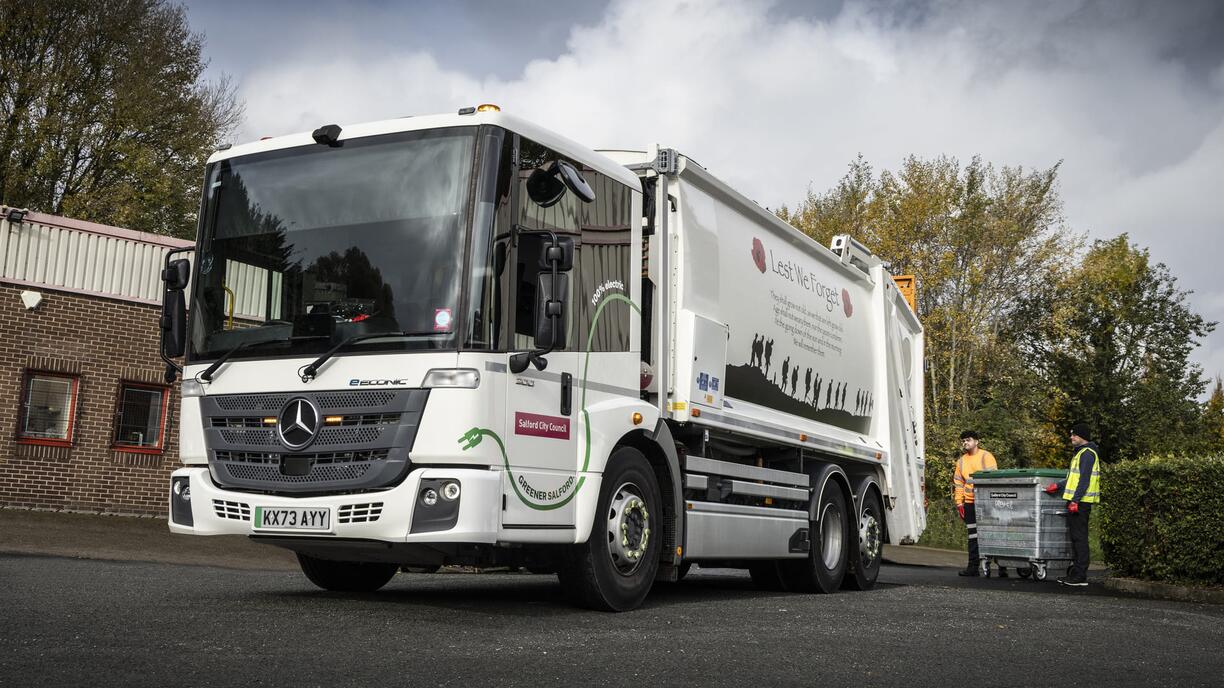
Following in the tyre tracks of the Econic, Mercedes-Benz has electrified its urban distribution model. The eEconic is targeted at inner city work as an electric solution for the likes of refuse, dropside, tanker and refrigerated applications. The low-entry cab is designed to improve visibility and dramatically reduces blind spots for drivers who spend most of their time navigating busy roads amongst a variety of other road users and pedestrians. Like the rest of the Mercedes-Benz Trucks range, safety equipment is at the forefront, and the electric powertrain enhances the driver experience.
Reasons to buy:
- Excellent safety specification
- Cabin opts for function over style
- Low-entry cab offers good visibility

Engines
Mercedes-Benz Trucks equips the eEconic with three battery packs totalling 336kWh capacity. Depending on the application, range is estimated between 60 and 95 miles. The e-axle, which features two integrated electric motors, has an output rated at 330 kW continuous power and 400 kW maximum. While most fleets will likely charge the eEconic overnight on a slower charger, fast charging at 160 kW can take the state of charge from 20 to 80 per cent in around one hour and 15 minutes.
Expert rating: 3/5

Transmission
The transmission setup in an electric truck is slightly different from your standard diesel but the eEconic has two forward gears plus two reverse years. Instead of a mechanical power take-off (PTO), the eEconic can be fitted with an ePTO which can provide around 30 kW continuous power and roughly 52 kW peak power at 50 per cent charge. As many eEconics will be fitted with auxiliary equipment such as refuse bodies and vacuum tankers, range and auxiliary power demands need to be appropriately managed to ensure the vehicle can complete a day’s work.
Expert rating: 4/5

Cabs
Visibility is the number one priority in the eEconic, so it’s more like driving a bus than a truck. The two-step low entry cab features a full-length folding glass door on the nearside and a standard door with a low belt line on the driver’s side. The huge windscreen and low seating position puts the driver at eye level with cyclists and pedestrians. Since it’s designed to be a crewed vehicle, there’s a central seat and a non-protruding dashboard to make it easy to move through the cab.
Expert rating: 4/5

Comfort and storage
First and foremost, the interior is centred around functionality. Driver and crew fatigue is minimised through the low-entry two-step access, flat floor and good standing room inside. Behind the seats, hooks and two slim overhead storage compartments offer some stowage capacity. In front of the central passenger seat there’s an elasticated pocket to keep odds and ends organised. A door pocket on the driver’s side is ideal for paperwork and a tray in the centre of the dash is a convenient extra storage area. The infotainment touchscreen is easily accessible and features a row of shortcut buttons along the bottom to make it simpler to operate on the go.
Expert rating: 3/5

Safety
As well as maximising direct vision through the cab design, Mercedes-Benz Trucks integrates several additional safety aids. A second screen mounted on the dash shows camera views directly in front of the vehicle, to the rear and both sides. An additional stalk behind the steering wheel allows the driver to quickly flick between these views on the go. Unlike its mirror cam systems on its larger vehicles, Mercedes-Benz Trucks hasn’t yet fitted the eEconic with this technology. That’s not necessarily a bad thing though, the side mirrors are nearly frameless and provide the depth perception that camera systems can sometimes lose. Blind spot monitoring is integrated into the A pillars and alerts the driver with visual and audible warnings.
Expert rating: 4/5

Handling
The example we drove was fitted with a rear steering axle which makes a huge difference to the truck’s manoeuvrability. In tight urban environments, this makes the driver’s life significantly easier. Depending on the scenario, it can be turned off but most drivers will want to keep the rear steer functionality on all the time. The electric powertrain offers smooth power delivery, and the vehicle pulls away much quicker than a diesel truck would. Noise inside is also dramatically reduced. Using the gear selector stalk, drivers can control four levels of regenerative braking, just like they would an engine retarder. This familiar operation means it’s intuitive for drivers swapping over to electric for the first time.
Expert rating: 5/5

Running costs
Provided fleets can secure low energy tariffs and predominantly charge at the depot, running costs should be cheaper than a diesel equivalent. Since the eEconic is designed to operate in an urban environment, it’s expected to work on a back-to-base model where overnight charging reduces the need for expensive fast chargers. However, compared to its diesel counterpart, the eEconic will be more expensive upfront which means fleets will likely want to hold onto the vehicle for longer. With fewer moving parts to go wrong, extending its lifespan shouldn’t be an issue.
Expert rating: 4/5

Warranties and dealer networks
As standard, the eEconic comes with a 12-month, unlimited mileage warranty for the whole vehicle when it’s sold through an authorised dealer. The driveline is covered for up to 36 months or 1200 charging cycles from delivery. The high voltage batteries come with a six-year warranty (1800 charging cycles) to ensure the batteries remain above 80 per cent state of health. Staying within the dealer network for maintenance is likely to be the best option as independent workshops slowly upskill technicians to handle high voltage equipment. Mercedes-Benz Trucks has around 70 dealer points across the UK working with franchise partners.
Expert rating: 4/5

Why buy?
Pairing the eEconic with the right duty cycle and type of work is the most important factor in its success. Its chassis and cab design are ideal for urban applications where visibility and manoeuvrability are vital. The eEconic’s range capabilities have been configured around this type of work so if the route is balanced with on-board equipment power draw, then it will be able to replace diesel equivalents without a problem. As with any electric truck, working out the right charging infrastructure and managing the upfront cost by keeping the vehicle for longer will be key to making the business case line up.
Expert rating: 3/5