Iveco Eurocargo CNG (2026 - ) review
The Iveco Eurocargo CNG is a great option for fleets looking to decarbonise their services without making huge operational changes

The Autotrader expert verdict:
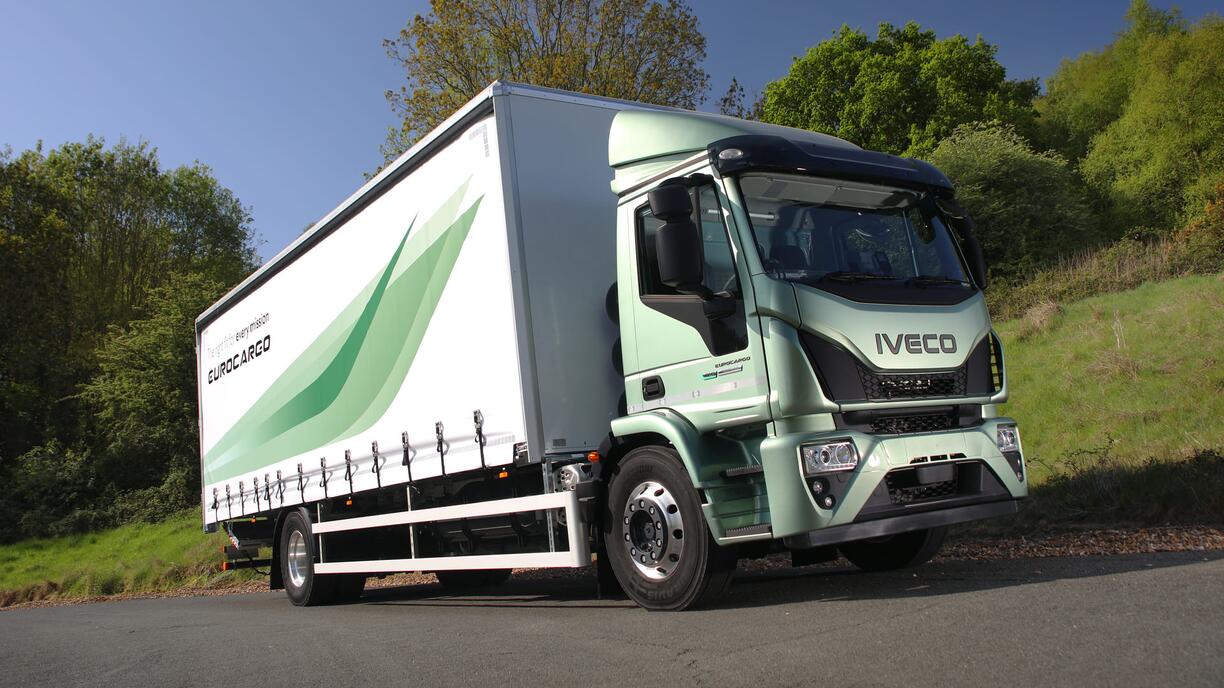
Since the early ‘90s, the Eurocargo has catered to the 11 to 18-tonne rigid market in Iveco’s truck lineup. Slotting into the regional and urban distribution market, the Eurocargo can be tailored to just about any application imaginable. A selection of wheelbases, cabs, fuel types, transmission and suspension options offer more than 11,000 possible configurations. For this review, we’ll be focusing on the compressed natural gas (CNG) fuel type which helps fleets to cut emissions by up to 90% when using bio-CNG.
Reasons to buy:
- Wide selection of wheelbases, cabs, etc
- Compressed natural gas model
- Strong automatic gearboxes

Engines
Eurocargo CNG comes with three versions of Iveco’s 6.7-litre CNG engine, mirroring the core diesel offering. The entry-level 220hp engine has 800Nm of torque, the 250hp version gets an extra 50Nm of torque and the 280hp option ups it to 1000Nm of torque. While CNG doesn’t eliminate tailpipe emissions, its production is cleaner than diesel resulting in a reduction in well-to-wheel emissions. However, CNG emits less particulate matter and NOx emissions at the tailpipe, contributing to improved localised emissions.

Transmission
Iveco has recently introduced a ZF gearbox to the Eurocargo, so it’s now available with an eight-speed automatic ZF transmission. For specific use cases, a six-speed Allison automatic transmission is optional. The example we tried was fitted with a seven-level exhaust brake which instantly reacts and can be used instead of the foot brake in most scenarios, reducing brake wear.

Cabs
Four cab variants can be paired with a diesel powertrain but the CNG version is only offered with a low roof day cab. This is likely because Iveco anticipates CNG users will typically work on a back-to-base model and refuel either at the depot or at a local refuelling station where infrastructure allows. Lighter 11 and 12-tonne models come with one-step access into the cab while the 12 to 19-tonne variants are a short two steps up. Sleeper and crew cab versions are available with diesel engines and the CNG day cab can be had with two or three seats.

Comfort and storage
For a day cab, the Eurocargo CNG has a useful array of storage solutions. In the two seater version, a storage compartment between the seats has ample room inside and its lid folds out into a makeshift tabletop or desk with an adjustable reading light. Along the side of this unit is a pocket for paperwork and the back wall of the cab has two large pockets for things like laptops, books, and tablets. A rail with a number of sliding hooks offers a useful place to hang up a coat or high vis jacket to keep the cab clutter free. The Eurocargo now has a 7-inch infotainment screen on top of the dash for phone connectivity and DAB radio. Since it was added into the interior rather than incorporated as a design element of the dash, it’s just out of reach to use comfortably on the move. We found it was easier to set it before taking off rather than try to fiddle with it out on the road.

Safety
Much of the safety information is communicated through the instrument panel display. As the Eurocargo hasn’t yet received camera mirrors like the Iveco S-Way and X-Way, the blind spot information system is integrated into the A-pillars. An orange light shows on the corresponding side if a vehicle or vulnerable road user is present in the truck’s blind spot and it turns red when something is very close. The simplicity of the light signals makes it intuitive to understand, although the system can be a bit too sensitive and indicate there is a vehicle in the blind spot when there isn’t. A reversing camera view displays on the central infotainment screen which eliminates the blind spot at the rear of the vehicle during manoeuvres.

Handling
The CNG powertrain behaves in much the same way as a diesel, so acceleration and engine braking feel familiar. The only slight difference is the CNG engine runs quieter than the diesel. Even unloaded, the Eurocargo feels settled on the road and torquey enough for urban and regional applications. The version we tried was fitted with a seven-stage exhaust brake which feels overly specified for local work but acts as a credible replacement for the footbrake in most instances. Its quick response time means drivers can use the exhaust brake more frequently to reduce brake wear over time.

Running costs
Lower fuel costs should mean that running a CNG truck is cheaper than its diesel equivalent, despite a higher upfront cost. However, operators should be aware that maintenance costs could be higher due to regular checks on things like spark plugs and oil changes. Optimising running costs starts with making sure the vehicle will get high utilisation to make the additional investment worthwhile. Transitioning to any new fuel like CNG also requires an adjustment period to settle into the best maintenance routine and driver training programme. As with diesel and electric trucks, drivers should be trained in efficient driving styles to get the most out of the fuel on-board. The Eurocargo CNG comes with six CNG tanks which offer a range of around 600km, or an additional three tanks can be added to up the range to 900km.

Warranties and dealer networks
Iveco has a good dealer network throughout the UK, supported by around 15 dealer partners including the likes of Guest, Acorn Truck Sales and North East Truck & Van. Modular repair and maintenance contracts can be added at point of sale to ensure the local dealer has the right equipment and training needed to look after a CNG truck.
Why buy?
Decarbonising transport is a challenge for fleets but CNG is a practical solution that can be implemented today with very little operational differences. Provided the depot is located close to an existing public CNG refuelling station or has room to store fuel on site, then the Eurocargo CNG is a great way to reduce emissions in an operationally comparable way to a regional distribution diesel rigid. An array of vehicle weights and configurations makes it easy to specify the best fit for the job and the day cab has heaps of useful storage pockets to keep paperwork organised. Compared to the rest of Iveco’s range, the Eurocargo interior feels a little dated but still has the functionality and safety integration needed to confidently navigate urban areas.