Advice
Vehicle excise duty: Car tax rates from 1 April 2026 onwards
Find out how VED tax bands work and how much tax you’ll pay for a new or used car in 2026.

Words by: Nimisha Jain
Published on 31 March 2026 | 0 min read
• Car tax is set to increase from 1st April 2026 onwards
• Only EVs worth over £50,000 will pay luxury car tax • While Vehicle Excise Duty (VED) is the official term, it’s commonly referred to as ‘car tax’. In this article, we’ll use the term ‘car tax’ to keep things simple. All drivers need to pay Vehicle Excise Duty (VED) - also known as vehicle tax, car tax, road tax or showroom tax – to keep driving on the UK roads. Car tax has evolved over the years. In 2017, the way vehicles were taxed was changed and Expensive Car Supplement, commonly known as luxury car tax, was introduced for cars costing over £40,000. In the latest Autumn Budget of 2025, the government has announced more changes to car tax from April 2026 onwards. In this article, we’ll go through all the new changes coming into place, as well the how to check which tax band your car falls in.
• Only EVs worth over £50,000 will pay luxury car tax • While Vehicle Excise Duty (VED) is the official term, it’s commonly referred to as ‘car tax’. In this article, we’ll use the term ‘car tax’ to keep things simple. All drivers need to pay Vehicle Excise Duty (VED) - also known as vehicle tax, car tax, road tax or showroom tax – to keep driving on the UK roads. Car tax has evolved over the years. In 2017, the way vehicles were taxed was changed and Expensive Car Supplement, commonly known as luxury car tax, was introduced for cars costing over £40,000. In the latest Autumn Budget of 2025, the government has announced more changes to car tax from April 2026 onwards. In this article, we’ll go through all the new changes coming into place, as well the how to check which tax band your car falls in.
Car tax changes from 1 April 2026 onwards
During the Autumn Budget 2025, the Chancellor announced three important changes to car tax that may affect you:
1. New ‘pay-per-mile’ tax introduced
A new ‘pay-per-mile’ tax – also known as eVED (electric vehicle excise duty) – will be implemented on all electric vehicle (EV) and plug-in hybrid (PHEV) drivers from April 2028 onwards. With this tax, EV drivers will pay 3p per mile and PHEV drivers will pay 1.5p per every mile they drive. The tax would be paid annually based on an estimate of their mileage, with any excess or deficit paid adjusted at the end of the year.2. Luxury car tax threshold increased to over £50,000 for EVs
On a more positive note, the threshold for luxury car tax, formally known as Expensive Car Supplement, will be increased from the current £40,000 to £50,000 from 1 April 2026 onwards for all EVs. Plus, this change will be retrospectively implemented on all EVs bought on or after 1 April 2025. This news came as a welcome change for all current EV drivers and anyone considering buying an electric car.
3. Vehicle Excise Duty will be increasing from 1 April 2026 onwards.
As has been the case since 2010, VED will be increasing again in line with inflation. The exact figures are yet to be announced.How much car tax do I have to pay?
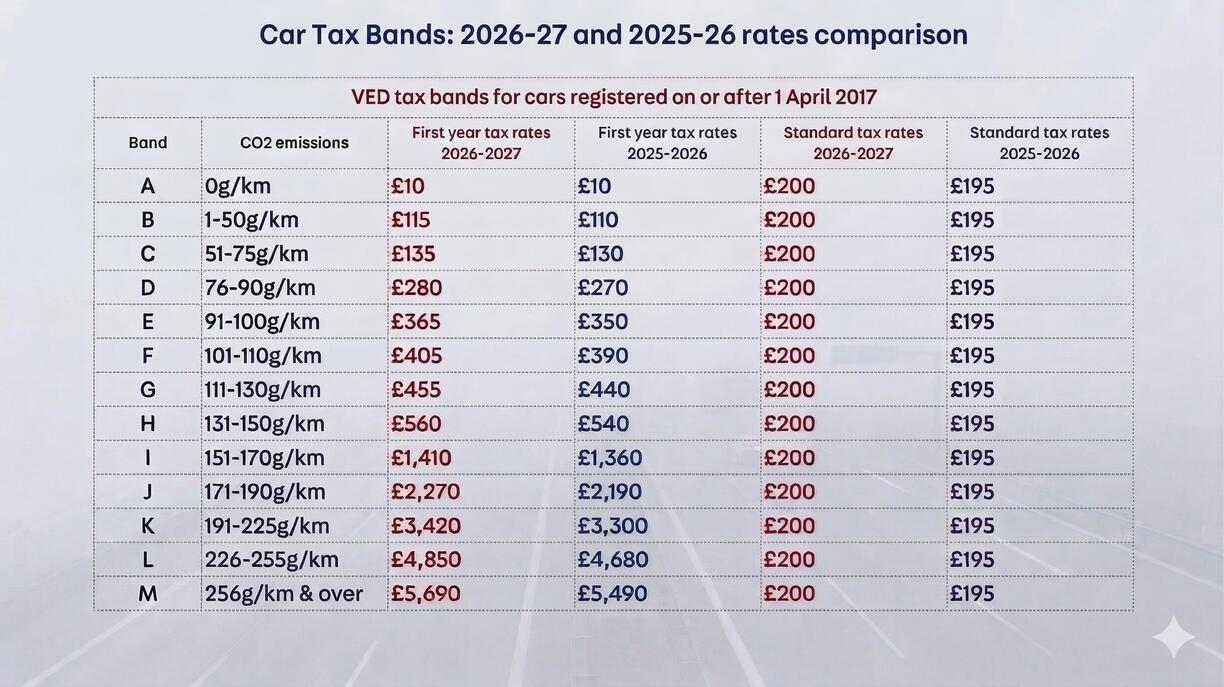
There are different tax bands that a car may fall in. Your car’s tax band will depend on: • When your car was first registered • How old your car is • How many emissions your car produces • The value of your car Bigger, older engines tend to produce more CO2, and so you pay more tax on them.Tax bands for cars registered on or after 1 April 2017
Cars registered after April 2017 pay a first-year tax that depends on your car’s CO2 emissions, followed by a standard car tax from year two onwards which stands at £200 from 1st April 2026 onwards. If this is the first time you’re paying tax on your car, the first-year VED rates are as follows: • Band A: Cars that produce 0g/km of CO2 will pay £10 in VED • Band B: Cars that produce 1-50g/km of CO2 pay £115 • Band C: Cars that produce 51-75g/km of CO2 pay £135 • Band D: Cars that produce 76-90g/km of CO2 pay £280 • Band E: Cars that produce 91-100g/km of CO2 pay £365 • Band F: Cars that produce 101-110g/km of CO2 pay £405 • Band G: Cars that produce 111-130g/km of CO2 pay £455 • Band H: Cars that produce 131-150g/km of CO2 pay £560 • Band I: Cars that produce 151-170g/km of CO2 pay £1,410 • Band J: Cars that produce 171-190g/km of CO2 pay £2,270 • Band K: Cars that produce 191-225g/km of CO2 pay £3,420 • Band L: Cars that produce 226-255g/km of CO2 pay £4,850 • Band M: Cars that produce anything above 255g/km of CO2 pay £5,690 as the first-year rate Bear in mind, if you drive a diesel car that doesn’t meet the Real Driving Emissions 2 (RDE2) standards, you will have to pay higher first-year VED which mean your tax bracket will fall in one higher Band rate than it would’ve with a RDE2 compliant diesel car. All diesel cars that don't meet RDE2 standards with over 226/km CO2 emissions will pay £5,690 VED.Tax bands for cars registered between 1 March 2001 – 31 March 2017
Cars registered between 1 March 2001 and 31 March 2017 are banded according to their CO2 emissions.
VED rates for cars registered between 1 March 2001 – 31 March 2017 are as follows in financial year 2026-27: • Band A: Cars that produce 0-100 g/km of CO2 will pay £20 in VED • Band B: Cars that produce 101-110 g/km of CO2 will pay £20 • Band C: Cars that produce 111-120 g/km will pay £35 • Band D: Cars that produce 121-130 g/km will pay £170 • Band E: Cars that produce 131-140 g/km will pay £200 • Band F: Cars that produce 141-150 g/km will pay £225 • Band G: Cars that produce 151-165 g/km will pay £275 • Band H: Cars that produce 166-175 g/km will pay £325 • Band I: Cars that produce 176-185 g/km will pay £360 • Band J: Cars that produce 186-200 g/km will pay £410 • Band K: Cars that produce 201-225 g/km will pay £445 • Band L: Cars that produce 226-255g/km will pay £760 • Band M: Cars that produce anything above 255g/km will pay £790
VED rates for cars registered between 1 March 2001 – 31 March 2017 are as follows in financial year 2026-27: • Band A: Cars that produce 0-100 g/km of CO2 will pay £20 in VED • Band B: Cars that produce 101-110 g/km of CO2 will pay £20 • Band C: Cars that produce 111-120 g/km will pay £35 • Band D: Cars that produce 121-130 g/km will pay £170 • Band E: Cars that produce 131-140 g/km will pay £200 • Band F: Cars that produce 141-150 g/km will pay £225 • Band G: Cars that produce 151-165 g/km will pay £275 • Band H: Cars that produce 166-175 g/km will pay £325 • Band I: Cars that produce 176-185 g/km will pay £360 • Band J: Cars that produce 186-200 g/km will pay £410 • Band K: Cars that produce 201-225 g/km will pay £445 • Band L: Cars that produce 226-255g/km will pay £760 • Band M: Cars that produce anything above 255g/km will pay £790
Tax bands for cars registered before 1 March 2001
VED for cars registered before 1 March 2001 is based on the engine size. Your vehicle handbook will tell you the exact capacity of your engine.
If your vehicle’s engine is 1549cc or smaller, the tax rate is £220 if you make a single 12-month payment or £231 if you make monthly payments. For cars with an engine over 1549cc, you’ll have to pay £360 if you make a single 12-month payment or £378 if you make monthly payments.
If your vehicle’s engine is 1549cc or smaller, the tax rate is £220 if you make a single 12-month payment or £231 if you make monthly payments. For cars with an engine over 1549cc, you’ll have to pay £360 if you make a single 12-month payment or £378 if you make monthly payments.
Luxury car tax in 2026
All cars except for EVs pay a luxury car tax if the list price is more than £40,000. EVs pay luxury car tax if the list price is more than £50,000.
Luxury car tax currently stands at £425, and this kicks in when you pay your second lot of VED (i.e. after the first year is complete) and is payable on top of the standard rate of VED. You’ll pay this for five years from the second year onwards of your car’s registration.
Luxury car tax currently stands at £425, and this kicks in when you pay your second lot of VED (i.e. after the first year is complete) and is payable on top of the standard rate of VED. You’ll pay this for five years from the second year onwards of your car’s registration.
Tax exempt cars
Some cars are tax exempt, but you still need to register their tax with the DVLA for them:
1. Drivers with disabilities
Drivers with disabilities may also be entitled to free VED if they meet the following criteria: • Use a mobility scooter or similar • Receive the Disability Living Allowance mobility component’s higher rate • Receive a War Pensioner’s Mobility Supplement More information is available on Gov.uk.2. Historic cars
If a car is over 40 years old (from their date of manufacture, not date of first registration) then it can be classed as tax exempt. The exemption comes into effect every April, so April 2021 saw all cars built prior to 1 January 1981 become exempt. To be exempt, your car will need to be classified as a historic vehicle. You can do this at a Post Office, and you’ll need to take: • your log book (V5C form – needs to be in your name) • a vehicle tax reminder letter (V11 form) • a valid MOT certificate or evidence your car is MOT-exempt (V112 form)3. SORN cars
If you don’t drive your car anymore, and you’ve declared it as SORN, you’re not required to pay taxes on it. If you’ve already paid VED for the car and it has been declared SORN, you’ll get a refund for the rest of that time.FAQs:
Can I tax my car online?
Yes, you can tax your car online on Gov.uk using your logbook, V11 reminder or your new keeper slip to tax your car. Read our complete guide on how to tax your car.
When is my car tax due?
You can find out when your car tax online on gov.uk or by checking your V11 tax reminder letter.How do I cancel my car tax?
You can cancel your car tax by contacting the DVLA online or by writing to the DVLA by post. There are different forms that you may need to fill depending upon why you’re cancelling your tax. Read our full guide on how to cancel your tax to find out which form you need to fill.How to renew my car tax?
You can renew your car tax online, in-person at the Post Office or by phone. Remember, you must renew your car tax every year to keep driving your car in the UK. You can find our step-by-step guide on how to renew your car tax here.Can I tax my car without an MOT?
No, you must have a valid MOT certificate to tax or renew your car tax.Taxes work differently for vans. Find out how much tax you owe if you drive a van.
Interested in buying a low tax car? Browse from thousands of used and new electric cars on Autotrader.
Interested in buying a low tax car? Browse from thousands of used and new electric cars on Autotrader.