Ford Ranger PHEV vs Toyota Hilux 48V Hybrid
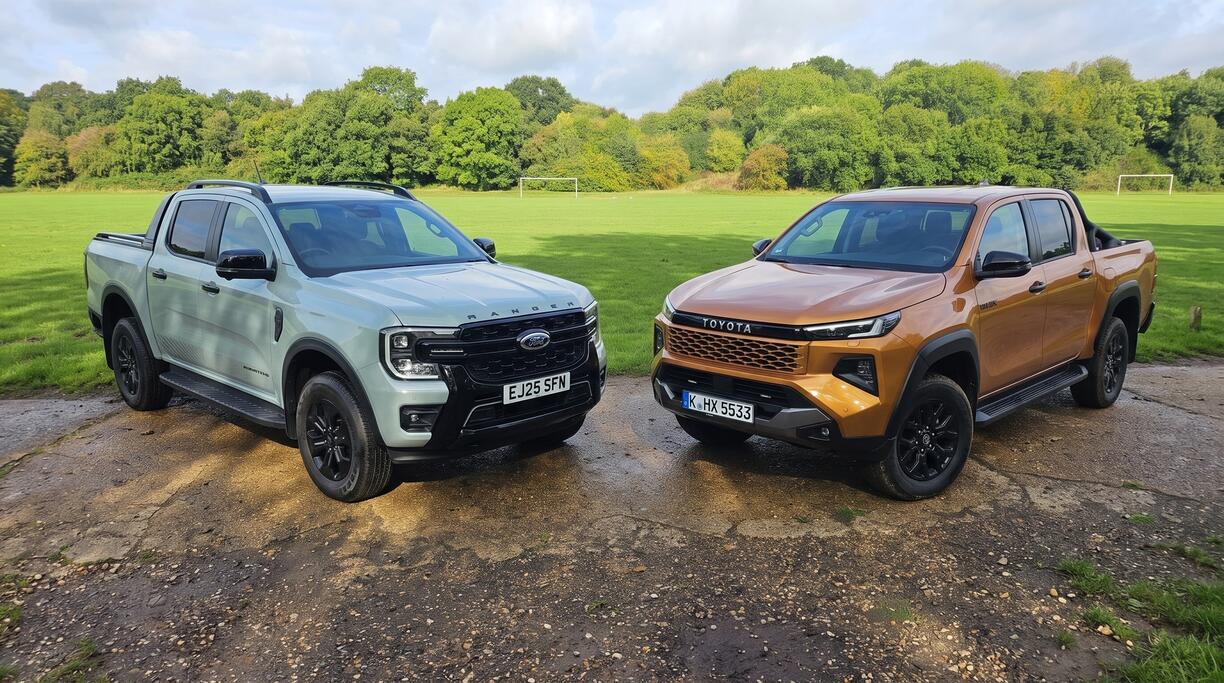
Two plug-in hybrid pick-up trucks – the Ford Ranger PHEV and Toyota Hilux 48V Hybrid – face off in our latest comparison article

Words by: Tom Roberts
Published on 10 November 2026 | 0 min read
The double-cab pick-up truck market has for the longest time been a diesel heartland… until now. We’re seeing manufacturers dipping their toes into pure electric waters – KGM Musso EV, Isuzu D-Max EV, Toyota Hilux BEV, to name a few – and some opting to make hybrids. In that latter category sit the Toyota Hilux 48V Hybrid and the Ford Ranger PHEV.
So, how’s that going to shape this article? Well, in the red corner sits the latest generation of Toyota’s trusted, go-anywhere pick-up truck packing a diesel mild-hybrid powertrain boasting subtle electric power here to sharpen the truck’s performance without breaking the bulletproof formula. And in the blue corner, Ford’s petrol-powered plug-in hybrid that promises zero-emission commutes and bags of torque bundled inside the top-notch Ranger experience we all know and love.
Pitting a Hilux and a Ranger against each other is an old-school rivalry, but today’s article examines their newest versions reborn in a partially-electrified era. Let’s kick things off with a good old comparison table of their key stats:
Toyota Hilux 48V Hybrid | Ford Ranger PHEV | |
Powertrain | 2.8-litre diesel engine and an electric motor-generator with 48V battery (mild hybrid) | 2.3-litre petrol engine and a 75 kW electric motor with 11.8 kWh battery (plug-in hybrid) |
Starting price | ~£36,000 (ex VAT) | ~£39,000 (ex VAT) |
Maximum payload | Over 1,000 kg | Over 1,000 kg |
Warranty length | Up to 10 years (three years standard, plus one-year annual service-activated rolling warranty) | Three years / 100,000 miles |
Cargo and practicality
The Toyota Hilux 48V Hybrid boasts a payload limit of just over 1,000 kg and a braked towing capacity of 3,500 kg. I was lucky enough to test this in the mountains of Bulgaria with just over 150 kg loaded over the rear axle and it showed zero strain. It’s available as a double cab only meaning it can be run as a commercial workhorse or family vehicle. It also has power sockets for three-pin plugs meaning you can power external appliances for remote working.
The Ford Ranger PHEV, meanwhile, has a maximum payload hovering at just over 1,000 kg across all trim levels and a braked towing capacity of up to 3,500 kg. The load space is available with a powered electric roller shutter (some trims have one fitted as standard) and an optional sliding loading rack for securing longer timber or pipe loads in place. The Ford Pro Power system is also included, offering three-pin power outlets (one inside the cabin and two within the cargo bed) for running power tools and equipment in remote locations.


Interior tech and comfort
The Toyota Hilux 48V Hybrid’s interior borrows heavily from the Land Cruiser with the cabin featuring elevated seating, dark grey trims, and physical buttons. Lower trims feature hard-wearing plastics and cloth, stepping up to not-leather, electric seats, and covered dashboard cubbies on high-spec models. You get twin 12.3-inch digital displays for the infotainment system and driver display with smartphone connectivity. But while the front seats get bags of room, the rear bench has tighter legroom than you’d expect, though it remains capable of seating three six-foot passengers.
And the Ford Ranger PHEV is a classic Ranger experience with a high-standard layout featuring plush fabrics or not-leather upholstery, with top trims (like the Stormtrak I was loaned) adding heated, electrically adjustable front seats. There’s also loads of storage thanks to a sweet dual glove box, door bins, phone slots, and (my favourite) pop-out dash cup holders. The dashboard is centred around a portrait touch-screen, but this vertical screen is not angled towards the driver, sticking straight out into the vehicle, although physical climate controls are present and not buried on the touch-screen!


Ride, handling and performance
The Toyota Hilux 48V Hybrid’s 2.8-litre diesel engine is paired with a 48V motor-generator mounted high to provide a 700 mm wading depth. The hybrid boost works silently in the background adding power when needed rather than being an always-on feature. It’s extremely capable on roads, but off the tarmac it glitters. It features selectable 4H/4L four-wheel drive backed by Toyota’s Multi-Terrain Select (MTS). The new Hilux features a new Electric Power Steering (EPS) setup that’s light at low speeds while firming up on faster off-road sections. In the mountains of Bulgaria through mud trenches and sweeping roadless environments I felt safe.
The Ford Ranger PHEV combines a 2.3-litre turbocharged EcoBoost petrol engine with a 75 kW electric motor and an 11.8 kWh battery pack. This allows it to deliver around 26 miles of pure electric driving, which means near-silent low-speed driving and instant torque. When uncharged, the petrol engine takes over… which means audible engine noise and increased fuel use. The extra weight of its battery pack pulls the vehicle to the floor eliminating the bouncy unladen body roll pick-ups sometimes give us. It retains the full 4x4 capability of any Ranger, tackling gravel bowls and agricultural tracks in its stride.


Safety and security
The Toyota Hilux 48V Hybrid is packed with the third-generation of Toyota’s Safety Sense suite and all the expected Advanced Driver Assistance Systems (ADAS). Standard safety equipment includes Blind Spot Monitoring, Safe Exit Assist, and Parking Support Brake.
While the Ford Ranger PHEV is backed by a Platinum Euro NCAP safety rating and features autonomous emergency braking, lane support, blind-spot monitoring, and driver attention alerts.
There’s little to choose between them here because their basic safety specs are both so high.


Verdict
So, which one will you choose?
On the one hard you have the Toyota Hilux 48V Hybrid which plays on its bulletproof, go-anywhere and mechanical dependability. It handles 1,000 kg payloads and 3.5-tonne towing effortlessly, and the rolling 10-year manufacturer warranty provides long-term peace of mind.
The Ford Ranger PHEV, meanwhile, offers short-distance electric commuting alongside the classic Ranger experience. It delivers sharper, more planted road manners than conventional diesel pickups, Ford’s top-tier styling, and practical perks like the sliding loading rack.
Despite the different powertrains, these two pick-up trucks are closer in capabilities than they might want to admit, and your choice will largely be down to budget and styling.
Both are the pinnacle of hybrid pick-up trucks right now… but which would you want to drive to the top of? Mount Ford or Toyota Peak?

