Guide
Key car finance terms explained (2025)
Navigate car finance with more confidence: the A-Z of jargon, explained.


Words by: Andrew Woodhouse
Last updated on 19 December 2025 | 0 min read
Car finance can be confusing, with lots of jargon like PCP, HP and CS. To make things easier, we've created this guide to explain what those terms mean, so you can confidently choose the car finance option that works for you.
Key terms at a glance
A
Administration fee
An administration fee, sometimes called an acceptance fee, is usually charged at the start of a finance agreement to cover the lender’s setup and documentation costs. It’s common on both PCP and PCH deals.
Agreement term
The agreement term is the set period over which you repay the finance, typically around three years, though this can sometimes be negotiated.
Annual mileage
The maximum number of miles you’re allowed to drive each year in your finance agreement before facing excess mileage charges. Estimate this figure when you sign up, as you’ll pay extra for any miles over the agreed limit.*
APR
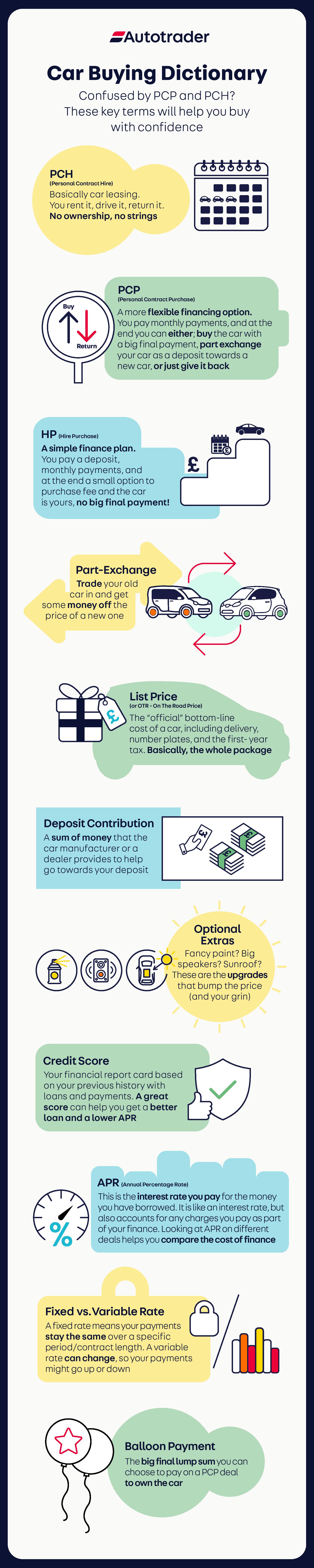
The Annual Percentage Rate (APR) shows the total cost of borrowing, including interest and fees, making it easier to compare finance deals.
Arrears
Arrears is the name for overdue money that’s owed and should have been paid back earlier. If you’ve missed a payment, you’ll be in arrears.
B
Balloon payment
A balloon payment is a larger final payment at the end of a PCP agreement, required to own the car. It’s set at the start and allows lower monthly payments.
C
CCD
The Consumer Credit Directive (CCD) is an EU law introduced in 2010 to ensure transparency and protect customers on credit agreements between €200 and €75,000.
Cooling-off period
Under the Consumer Credit Directive, you have 14 days from the day after you agree to a finance deal to cancel without penalty.
Credit agreement
A credit agreement is a legal contract outlining how much you’re borrowing and what you’ll repay over a specified period.
Credit history
Your credit history is a record of how your ability to repay debts, based on information from banks and other financial institutions, and is detailed in a credit report.
Credit rating
Your credit rating, or score, is a number that indicates how likely you are to repay credit. It’s based on your credit history and affects your ability to get loans, credit cards or mortgages, with lenders checking your credit file through a credit search.
Customer deposit
The initial payment made when starting a finance agreement. A larger deposit usually means lower monthly payments and can help approval.
D
Deposit contribution
A sum from the manufacturer or dealer towards your finance agreement.
E
Early settlement
Ending your finance agreement early by paying off the remaining amount owed, often including an early repayment charge.
Equity
Equity is the value of your car once all debts are paid. If the car is worth more than you owe, you have positive equity; if it’s worth less, you have negative equity.
F
FCA
The Financial Conduct Authority (FCA) is an independent body responsible for regulating financial services in the UK. They are independent of the UK Government and exist to help consumers get a fair and honest deal.
Finance agreement
A finance agreement outlines the terms of your finance contract, including monthly payments, cancellation, and what happens when the contract ends.
Fixed-rate interest
Fixed-rate interest means your monthly interest payments stay the same throughout your finance agreement. Car finance is usually based on a fixed rate interest.
G
GAP insurance
Guaranteed Asset Protection (GAP) insurance covers the difference between your car’s original value and the amount your insurer pays if it’s written off or stolen, protecting you against depreciation.
GFV
GFV (Guaranteed Future Value) is the predicted minimum value of your car at the end of your finance agreement, based on factors like mileage and contract length. Also known as GMFV.
Guarantor
A guarantor is usually a close relative who agrees to repay your debts if you can’t. Guarantors are often needed for those with little or no credit history, and guarantee agreements must be in writing. The lender can take legal action against you or your guarantor for unpaid debts.
H
Hire Purchase
Hire Purchase (HP) is a finance deal that normally consists of a deposit followed by fixed monthly payments. Under hire purchase, you don’t own the car until you’ve fully repaid the debt. Learn more about Hire Purchase in our guide.
J
Joint application
A joint application is when two people apply for car finance together. Both applicants will have to follow the same process and use their personal details as part of the application. They’ll be jointly responsible for repaying the loan or finance agreement.
P
Part exchange
In a part exchange, you trade in your car towards a new one, paying the difference with finance or cash. This option avoids the need to sell your old car. Learn more about part exchange.
Personal contract purchase
With Personal Contract Purchase (PCP), you’ll make monthly repayments after an initial deposit. You’ll only own the car if you choose to make a balloon payment at the end of the contract. You can learn more about PCP in our guide.
Personal loan
A personal loan allows you to borrow money and pay it back in fixed amounts each month. With a personal loan, you might opt to borrow the full amount for the car and then pay the debt back. This means you’ll own the car from day one, but you are not entitled to some of the protections offered by car finance if you can’t keep up with your payments.
R
Residual value
Residual value is the estimated worth of a car at the end of a finance. It’s calculated at the start and affects your monthly payments, so it’s wise to check this figure when considering a vehicle.
S
Secured loan
A secured loan uses an asset, such as your car, as collateral. If you miss payments, you could lose the asset. These loans typically have lower interest rates than unsecured loans.
Soft Search
A soft search, or quotation search, is a credit check by finance companies to assess the risk of lending money to you. It does not impact your credit score.
T
Term length
Another name for the agreement term, this is the length of time you’ll be paying your finance agreement.
Total repayable
This is the total amount you’ll repay the lender over the course of your finance agreement. It will include the loan itself, plus the total cost of credit, interest and fees.
Transfer fees
An option to purchase fee can be anything from £1-£300, but typically is around £10.
The fee is required at the end of a hire purchase to take full ownership of the vehicle, and is paid in addition to your deposit and monthly payments.
The fee is required at the end of a hire purchase to take full ownership of the vehicle, and is paid in addition to your deposit and monthly payments.
Unsecured loan
Unsecured loans do not require collateral and usually come with higher interest rates and lower borrowing limits.