Is Polestar the greenest car company in the world?
We find out how the sporty Swedish brand is approaching Sustainability

Words by: Erin Baker
Published on 18 August 2026 | 0 min read
The most luxurious car brand in the world is Rolls-Royce. The sexiest car brand is Ferrari (well, until Luce…), the best-value is Dacia and the safest is Volvo. You can argue the toss, but you get the idea: these companies have been, for decades, leaders in their spheres, bywords for their strengths, the embodiment of their values. No one has got near them for 50 years or more.
But the world is changing, rapidly. Luxury, desirability, value, safety… These ideals are either in question, or are regarded as a common feature for all car companies now. New brands are challenging the leaders and, significantly, new ideals are replacing what consumers used to want. Rising up through the ranks, quietly but confidently, is a brand new ideal, a new marker of what consumers desire: sustainability.
We see it with food, drink, travel, fashion and homes: people want cleaner, greener brands. They want products that don’t damage the planet, and brands that help them reduce their own carbon footprints. And they don’t want to wear a hairshirt while doing it – they still want nice stuff.

So who is the new green queen of them all, the car brand blazing a trail, leaving others in its long shadow? There is one clear winner, a brand for whom sustainability is a company cult, a passion, a spiritual fervour driving its people back to the periodic table to examine new ways of creating chemistry. A company for whom, if told to jump, they don’t ask how high, but: is that really the best solution? A company for whom “net zero” is a dirty term, and “actual zero” is the only answer. Polestar.
Once the performance sub-brand of Volvo, the Swedish company Polestar became the electrification sub-brand, and then split away entirely to become its own entity: a smart, intellectually curious, critically understated brand that flies under the radar, despite its yellow seatbelts. While it remains under parent company Geely alongside Volvo, and shares much of Volvo’s parts and DNA, it has leapt ahead astronomically when it comes to decarbonising.

At the head of its efforts sits Fredrika Klaren, the calm, astute Scandinavian Head of Sustainability for the brand globally. She’s also a member of the Board of Directors for E-Mobility Europe and is across many of the critical EU regulatory discussions around decarbonisation. Under her watch, Polestar has built a new home for its ground-breaking endeavours in Gothenburg: Mission 0 House. A research centre with five-year funding which houses scientists from universities and the car industry, the mission after which it was named is “to eliminate greenhouse gas emissions in materials, products and processes”. Not to reduce or offset, note, but to eliminate.
“We’re kind of cultish around sustainability”, says Fredrika. “The people at Polestar don’t try to stand on two sides of history - we know what side we want to stand on. We have locked ourselves into a green technology, investment-wise. China is locked into a green economy now and is bending the curve.”

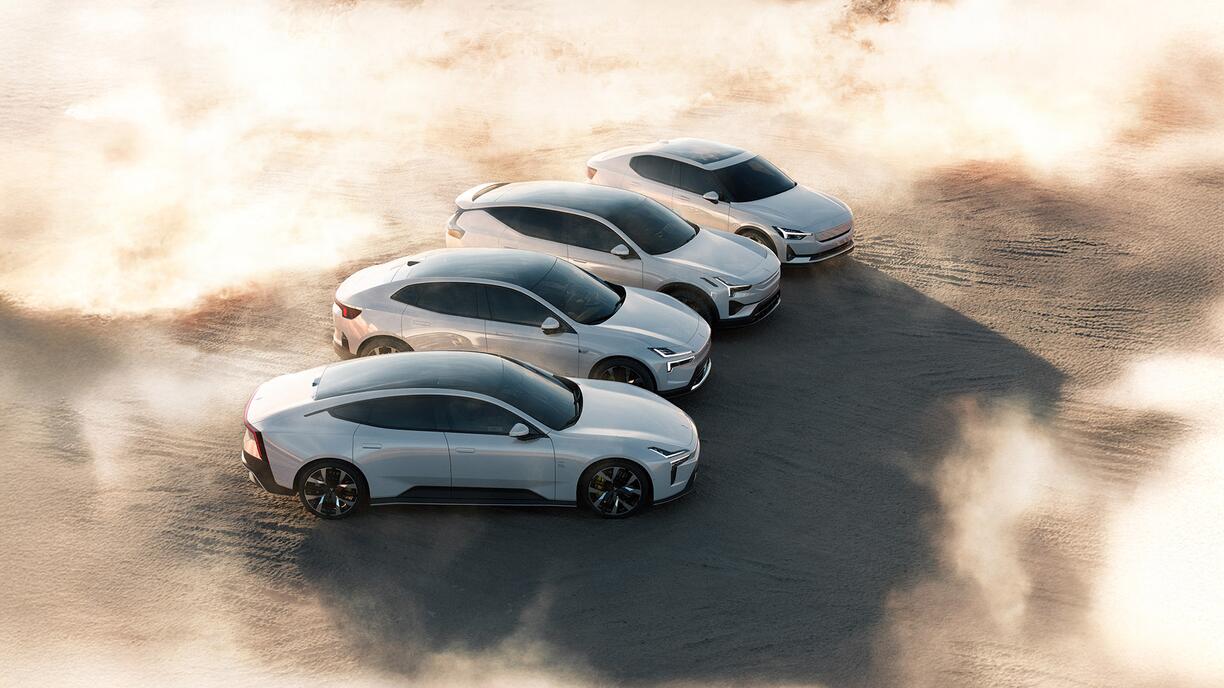
Polestar is heavily putting its money where its mouth is: its cars have the tonnes of CO2e they’ve saved in manufacture printed on the bodywork, as part of the design language. For example, the current Polestar 2 is three tonnes of CO2e per car lighter than the preceding version (a 12 per cent reduction in its carbon footprint), thanks to low-carbon aluminium in the wheels and the battery tray, and improvements in battery chemistry.
These seemingly dull-as-ditchwater facts and figures are turned into a positive attribute by the design team with the printing of them on the bodywork, blending aesthetics with a didactic pride about reducing carbon. Never has anyone combined science and art on the bodywork of a car to make a statement about sustainability. It’s innovation in action, and it’s exciting. It also builds trust with drivers about what the brand is doing behind the scenes and how much importance it really places on the environment: “Transparency is a way of building consumer loyalty. It’s a filter”, explains Fredrika.

One of the latest wins for Polestar is a 50 per cent reduction in virgin cobalt used in the batteries for Polestar 2 and 3, thanks to a supply of recycled cobalt. This means “reduced emissions, reduced resource depletion, and reduced pressure on social communities around the mines to pump out minerals.”
Polestar believes that you cannot separate ethics from sustainability. “Human rights and stewardship creates pressure; we’re going to need virgin and recycled [materials] for a long time” says Fredrika. If a car company is invested in a supplier that mines rare earth metals in Africa, then it must also be invested in supporting the local community and environment that is impacted by the mining.

Given the pressure on our planet to yield vast quantities of lithium, cobalt, manganese, copper, nickel and so on for electric-car batteries, is this really the way forward to save us from climate disaster? “We are trying to make people understand how electric [cars] helps us create so much value. Do you choose abundance [of renewable energy, recyclable materials, reusable batteries] or scarcity [of fossil fuels]? With EVs you get the Swiss Army Knife - it’s the only solution that can become circular - by recycling, repairing, we can create loops and revenue streams in a fantastic way.
“We can also sell the inherent value in the car to a third party. I’m all for mass balance systems. We also have smaller closed loops – with battery centres, we extend the lifetime of a component. So a lot of costs can be avoided, because battery recycling costs are high.
Battery minerals are like assets, rather than fuel out of the ground which is burned and disappears.”
What about the consumer? What if they don’t want to buy an electric car? What should the car brands or governments do? Force them into it? “Look at the fashion industry - they’re showing you can rewrite old truths about what you think consumers want and need. A fashion brand I used to work for [Kappahl] went out and said they will not sell pre-distressed jeans any more. It lowers the lifetime of the jeans drastically and it involves chemicals and lasers and plastics. When you dare go against what you think consumers want in the name of sustainability and probably cost efficiency, they are going to see so much value in this.”
