Primus Seat Covers for Volkswagen Transporter Kombi Vans | Van accessory review
In our first van accessory review we take a look at Primus Seat Covers’ set of seat protectors for the Volkswagen T7 Transporter Kombi

Words by: Tom Roberts
Published on 17 August 2026 | 0 min read
What seat covers are we testing in this review?
We are testing a set of seat covers made for the Volkswagen T7 Transporter Kombi that were sent to us by Primus Seat Covers.
Primus Seat Covers sent us a range of seat covers to test for multiple light commercial vehicles, but we have based this review on those covers specified for the Volkswagen T7 Transporter. These are the covers we were able to use the most on several long journeys and different use cases including holidays, with children and moving furniture, thus giving us the best opportunity to review them thoroughly.
You can buy seat covers for nearly any van available in the UK from the company, and the website is very easy to filter through to find the perfect seat cover set for your van. Every set comes in a nice box with easy-to-follow instructions and fitting videos on the website.
Here are the sets we tested:
But before we get going with the review, here are the two most asked questions on Google about seat covers for vans, and specifically leased vans:
Why do van drivers need seat covers?
Why are seat covers a good idea for leasing customers?
What seat cover sets did we test?
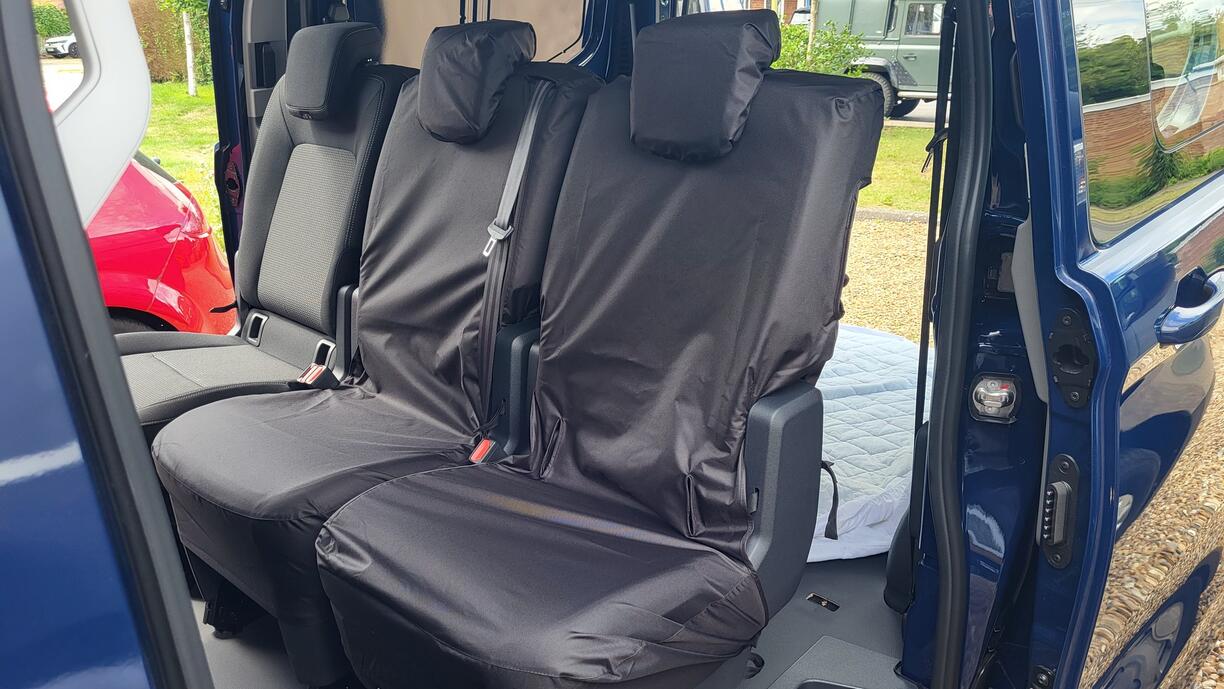
In the two sets from Primus Seat Covers for the Volkswagen T7 Transporter Kombi, we received three seat covers and head rest sheaths for the back row of seats and seat covers for the main driver’s seat, its head rest, arm rests and a bench seat cover set.
The Kombi we used to test the covers on had two separate front seats instead of a bench seat, so we were only able to use the driver’s seat cover set. However, you can buy a set that is made for two separate front seats from the company.

How easy were the seat covers to fit?
Thanks to easy-to-follow instructions and fitting videos on the company website, the seat covers were easy to fit on all seats. The driver’s seat set took us around 10 minutes to fit – made easier by removing the headrest – and it simply pulled down over the seat body and was secured in place by an adjustable velcro strap underneath. Velcro on the back of the seat cover holds it in place using the fabric at the back of the seat to prevent the material from riding up. The armrest covers took a moment to get into position the right way round, but once in place there was no material bunching at the hinges allowing them to move up and down easily.
The three back seat covers were only slightly tricky to fit because of how close together the seats themselves were. We removed all the headrests to put their sheaths on, and the two outer seats were just a simple case of pulling the covers over the seat body and securing in place by an adjustable strap round the back of the seat. Again, velcro on the back of the seat covers holds the cover in place on the seats backing material to stop it riding up.
The middle rear seat has a completely different design to accommodate the seat belt being mounted on the seat itself, rather than on the van’s interior like the outer seats. You still pull the middle seat’s cover down over the seat body, but it zips up on the front right side leaving a gap for the seat belt to run through. It is secured by an adjustable velcro strap at the back like the outer rear seat covers.
Each seat cover was very easy to fit, carefully designed and showed no major signs of stretching or crumpling into seat folds and mechanisms. We noted that it was only the outer seats on the rear row that showed any real sign of stretching, but when sat on the covers melted into the shape of the seats nicely. It’s also worth noting that where ISOFIX points were located on the seats the covers had slots hemmed into them. Very useful.

What are the seat covers like to live with?
The seat covers are made from a black waterproof polyester material that is surprisingly breathable and easy to clean. We had some quilted versions to trial, but decided to use the simple thin waterproof covers as the Kombi’s seats are already very comfortable. We were also pleased with how easy they were to wet and dry clean after a couple of food and drink spillages in the back row.
We were expecting the waterproofing in the materials to make sitting on them for long drives a sweaty experience… but it wasn’t. We drove the 200 miles to South Wales and back several times over the few months we had the seat covers on and never once experienced any uncomfortable heat generated by the seats, even in the middle of the UK’s 36-degree heat waves.
The seat material is also surprisingly easy to sit on, not being rough or noisy when you move around. My son spread himself out on the longer journeys to Wales and promptly fell asleep on the back seats… if they had been made of a rough, noisy and non-breathable material he would have woken up in a right state.

How well did they protect the seats?

Are the seat covers worth the money?

Verdict
While there are cheaper seat covers available, this is one of those van accessories where ‘you get what you pay for’ is very true. Primus Seat Covers don’t do anything other cover sets do, but we found the packaging, instructions and fitting videos to be very reassuring. We’ve seen this company’s products getting praise on other review sites, and our time with them only backs up the well-deserved and growing reputation.
Not for nothing, on my last lease vehicle upholstery wear was noted on the driver’s seat and I was charged a small fee that a seat cover would have eliminated. I’m not making the same mistake twice.