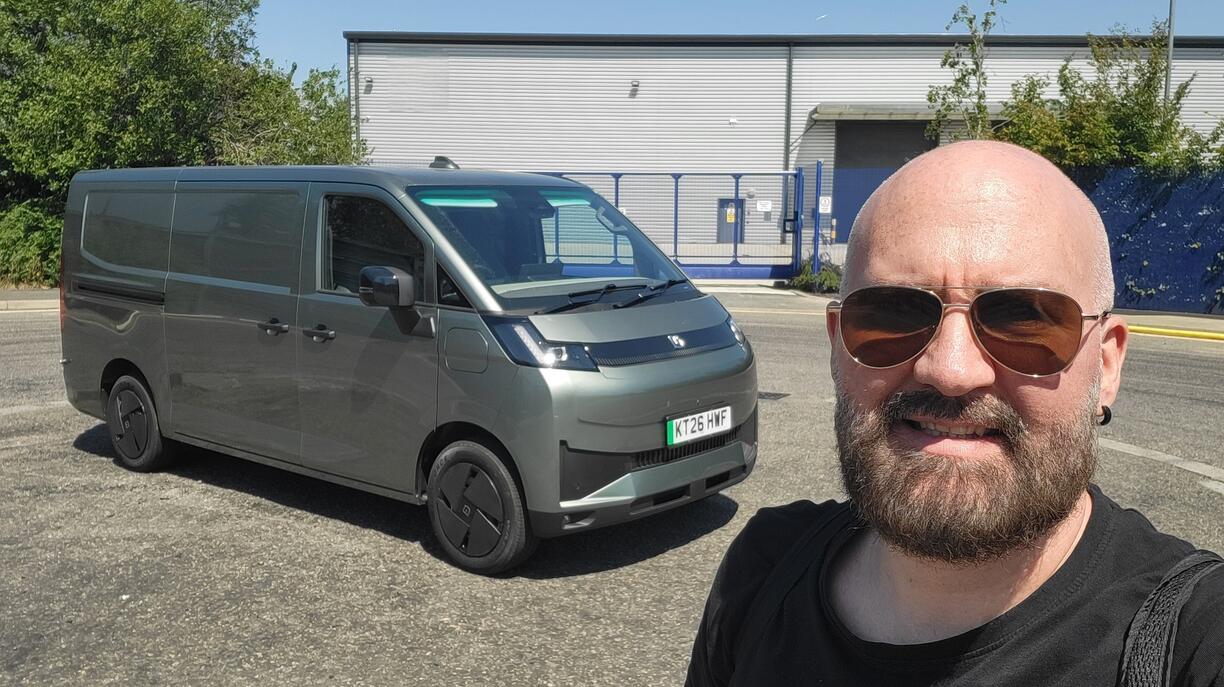
Farizon’s new V7E electric van is a well-rounded, medium-sized light commercial vehicle packed with equipment and real improvements on the company’s original van – the SV. The nuts and bolts are all here… a 6.95-cubic metre load volume, payloads of over 1,300 kg, ranges of up to 204 miles, an improved two-seat cabin, better connectivity and more. Its pricing is also strong starting at £28K (ex VAT) and it’s backed by a five-year / 120,000-mile warranty with four years of AA mobile roadside assistance. And yet its drive quality is very similar to the SV’s, feeling bumpy and unsure of itself when unladen, although slightly tighter when loaded. Its safety alerts are obnoxious, and its infotainment system still slow and awkward… but at least this Farizon van launched with Android Auto support from day one. Overall, the V7E is an improvement on the SV and a step forward for Farizon’s vans. After all, incremental improvements are better than no improvements, so the V7E deserves consideration on that point. It’s not as refined as Kia’s PV5 Cargo, but it is bigger and stacks up quite well against the Stellantis medium electrics. Test drives are a must because they’re the only way to make any kind of decision these days.
The V7E is only offered in one L1H1 body type providing a maximum load volume of nearly seven cubic metres making it a very familiar ‘medium van’ size. It can carry payloads of up to 1,338 kg, if you opt for the 50 kWh battery, although those fitted with the largest 67 kWh battery can carry up to 1,208 kg. We’re pretty sure most people will want the larger battery pack, so keep the 1200 kg payload in mind as you read this review because that is still a strong payload in the medium electric van market. The dimensions of the boxy cargo space are generous at 2.7 metres long, 1.69 metres wide above the wheel arches, and 1.43 metres high. The load space is fully lined, which will protect the metalwork from bumps and scrapes. Access is good with two side sliding doors as standard and two 270-degree opening rear doors with stoppers to keep them from clanging against the van’s side panels. It can tow up to 750 kg unbraked and 1,000 kg braked if you opt for the towing package. The only practical drawback is the V7E can only carry two people, but a third person would have been squeezed in uncomfortably so we understand why Farizon kept it simple.
Expert rating: 4/5
Farizon V7E interior
Interior
The V7E’s interior looks and feels durable. Light grey fabrics and plastics are the theme of the day, making it feel quite airy. It’s a two-seat cabin, with a middle space on the wider passenger seat for a fold-down armrest with cupholders. The driver’s seat is ventilated with six-way manual adjustment and lumbar support… and the steering wheel is adjustable for reach and rake, unlike the SV’s. The interior is packed with storage, including a big compartment under the front passenger seat, a glovebox, door storage and trays along the main edge of the dashboard. The 12.3-inch touch-screen infotainment system features Bluetooth connectivity, DAB radio, Apple CarPlay, and Android Auto, although its software is slow and we much preferred screen mirroring from our mobile phone. The seven-inch LCD driver instrument display is crisp, although so packed with tiny writing and information it’s sometimes hard to know what to look at first. You can sometimes activate a feature or change driving mode and have to search the screen for some indication you’ve achieved your goal. The air conditioning is VERY efficient and proved its worth on a 190-mile round trip to Oxford in 32-degree heat… and you have actual physical buttons to control it with! We never felt uncomfortable sitting in traffic, but driving it was another matter.
Expert rating: 3/5
Farizon V7E charging port
Running costs
The V7E excels in this section for several reasons: its prices start at £28,000 (ex VAT) for the 50 kWh model (although the range is lower) and £30,500 (ex VAT) for the 67 kWh model, it’s covered by a five-year / 120,000-mile manufacturer warranty with four years of breakdown cover, and its charging speeds are good. Of course, charging at home is cheaper than public, with the former dependent on your own energy tariff. Energy consumption is very good and we proved that with an 82-mile journey to Oxford from Hemel Hempstead on the 67 kWh model we were loaned. Here’s how it broke down… we started with 90 per cent charge and 181 miles of range, and finished with 61 per cent charge and 123 miles of range. The 82-mile journey only ‘cost’ us a 29 per cent drop in battery charge, which means we used 19.43 of the total 67 kWh available. So, the 82 miles driven divided by the 19.43 kWh of charge used equals an efficiency of 4.2 miles per kWh – way above what we expected. When loaded with around 350 kg of materials on our return journey, that dropped to around 2.9 miles per kWh. Pretty impressive considering the return journey was mainly motorway driving and we had the aircon up full whack!
Expert rating: 4/5
Farizon V7E side view with all rear doors open
Reliability
Longer-term testing is definitely required to speak of the reliability of the V7E. However, the five-year / 120,000-mile warranty is certainly a confident show from Farizon, and it's backed up by four years of breakdown cover and a network of aftersales destinations. We will update this section if and when we hear of any reliability points.
Expert rating: 3/5
Farizon V7E driver information display
Performance
The V7E’s motor drives the front wheels and delivers 147 horsepower up to a top speed of 75 mph. You’ve got the usual driving modes – Eco and Normal – that adjust power, speed, and regenerative braking accordingly. It goes when you need it to and the regen braking works well, as you can see from our consumption figures above. It’s about as by-the-book as a medium electric van can get, really.
Expert rating: 3/5
Farizon V7E wheel
Ride and handling
One area it does fall short is drive quality. However, the company’s drive-by-wire technology is impressive and appears to have lost the slight lag between inputs we noticed on the SV. That said, unladen driving is bumpy and uncomfortable with the independent front suspension and rear leaf spring setup making for an unsettling combination. Loaded up it feels better and more planted to the ground, but the reality is that vans are driven unloaded depending on use case. For an always-loaded business, drive quality will be fine, but delivery businesses will probably want something a bit more consistent so as not to hack off its drivers. It is very manoeuvrable, however, with a good turning circle and confident steering… but the haptic feedback and lane assist are aggressive, and we felt more comfortable driving it with those systems deactivated. We expected a better driving experience than the company’s SV van and didn’t get it, which did leave us feeling disappointed.
Expert rating: 3/5
Farizon V7E reversing camera and around-view display
Safety
The V7E is a tough van built with high-strength steel and a safety cage structure. There are the usual passive systems like airbags and seatbelts (of course) and 17 active safety systems. These include Autonomous Emergency Braking, Lane Keep Assist, Lane Departure Warning, Adaptive and Intelligent Cruise Control, Blind Spot Detection, Rear Cross Traffic Alert, Driver Monitoring System and Hill Descent Control. Although be warned that the alert sounds (and the systems themselves) are super vigilant and WILL bing and bong at you constantly unless you switch the alerts off. It becomes a frustrating van to drive when you couple constant squawky noises and bumpy ride quality. However, the fact it comes with a 360-degree around-view camera and front and rear parking sensors as standard is a big plus in our eyes.
Expert rating: 4/5
Farizon V7E cabin controls
Equipment
There’s a lot of equipment on the V7E, especially impressive when you consider the price. Highlights include the LED headlights with automatic high beam control, LED daytime running lights, front/rear fog lamps, and electrically adjustable and heated door mirrors. Every V7E gets the 12.3-inch infotainment touch-screen (and the slow user interface), the seven-inch driver information display, air conditioning with physical controls (we love a proper button), and a spare wheel. Power sockets are everywhere with USB connections and a 12V socket in the cabin, and a 220V / 2.2 kW Vehicle-to-Load (V2L) three-pin socket in the cargo bay for powering tools (or a coffee machine… try it).
Expert rating: 4/5
Farizon V7E rear three-quarter view
Why buy?
You’ll buy the Farizon V7E because you’re looking for an affordable medium electric van and you spot one on a good finance or lease deal. Which sounds like the most obvious statement ever. Sit the V7E against any other medium electric and it’s definitely worth a test drive to compare. We can’t say it’ll work for everyone, but we’re confident the packed equipment list and practical load space will turn some heads… especially when the price is factored in.