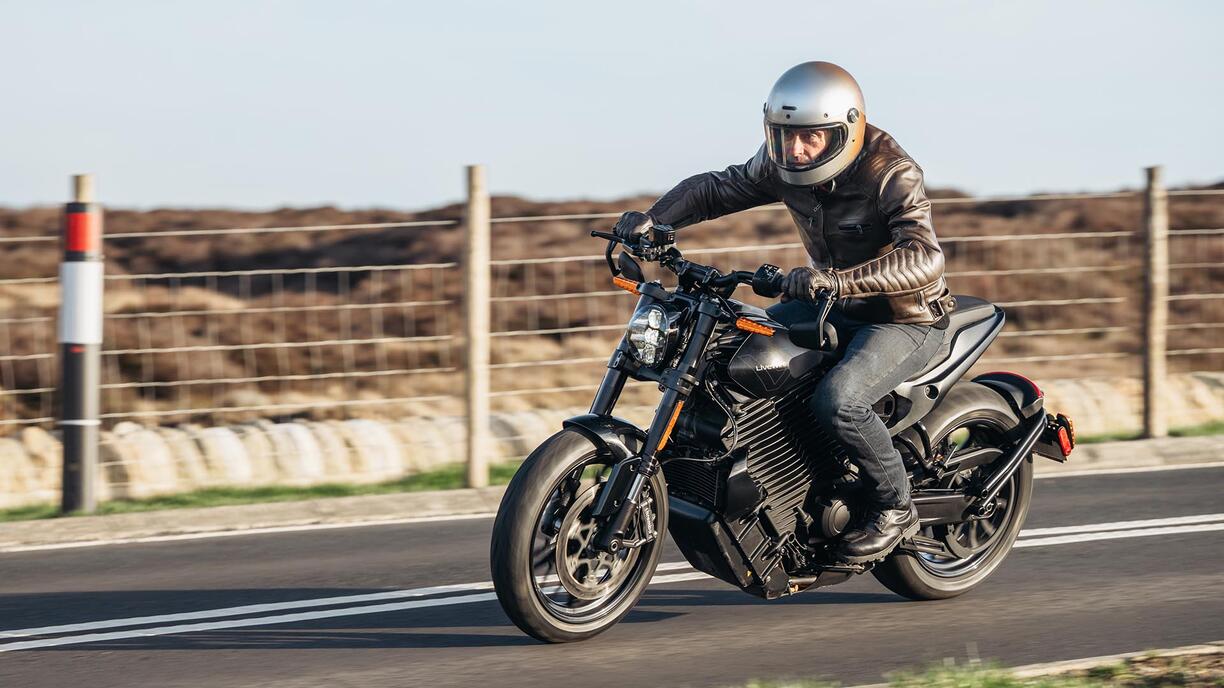
Harley-Davidson’s electric sub-brand hits its stride with a new family of bikes headed up by this hipster-friendly S2 Alpinista
Share
The Autotrader expert verdict:
4
Rating: 4 out of 5 stars
Harley-Davidson was an unlikely electric pioneer with its original LiveWire, this spawning the standalone sub-brand under which this S2 Alpinista and a family of related bikes now sell. These share a common platform, battery and motor system and a similar hipster-friendly aesthetic neatly combining traditional custom looks with modern hipster cool. In price and performance the S2 range can be considered comparable to the Nightster family in the traditional Harley line-up, as well as new electric rivals like the Honda WN7. Against which LiveWire’s considerable head-start in building electric bikes shows in terms of range, performance and usability.
“The S2 Arrow platform is very much of the moment, though, with a modular aluminium frame built around a hefty 10.5kWh battery”
Crazy to think something as futuristic as the S2 Alpinista shares anything whatsoever with a brand as defiantly old-school as Harley-Davidson but the ties remain close, even with LiveWire now standing on its own two feet thanks to additional outside investment. The Harley name is still on the bike, though, and for all the differences in propulsion, a common spirit remains. Technically the S2 Arrow platform is very much of the moment, though, with a modular aluminium frame built around a hefty 10.5kWh battery pack and motor unit driving the rear wheel via a belt. Tech is impressive, with plenty of riding modes, phone connectivity and lean-sensitive ABS and traction control. Suspension and braking is more conventional, with adjustable Showa cartridge forks, a linkage-driven monoshock and designer-label Brembo calipers and levers. Of all the bikes built on the S2 Arrow platform the Alpinista presents as the sportiest on its matched 17-inch wheels, the Del Mar using a more cruiser-like set-up with a bigger front wheels while the flat-track inspired Mulholland uses paired 19s.
Expert rating: 5/5
Riding position
“The riding position mildly stretched but still upright enough to be comfortable and wieldy in traffic”
A low 749mm seat and slim spine make the Alpinista feel smaller and more manageable than you might first expect, the riding position mildly stretched but still upright enough to be comfortable and wieldy in traffic with impressive sounding peg clearances for getting your lean on. If that sounds a little too racy for your tastes there’s always the Del Mar with its 19-inch front wheel and more cruiser-like vibe.
Expert rating: 4/5
Practicality
“The charge port is a ‘Type 2’ AC, so you can’t use the ‘tethered’ DC rapid chargers like you can with the Honda WN7”
Setting aside means of propulsion for a second the Alpinista is a minimalist naked roadster, so there’s not much to protect you from wind, rain or spray if you ride it in all weathers. It’s low and narrow enough to feel nice and chuckable in traffic and when filtering, though, the near-useless under-bar mirrors the only real practical issue along with the pretty minimal looking perch for your pillion. Range and charging are important considerations for an electric bike, meanwhile, and the Alpinista’s claimed 89 miles on a ‘combined’ test cycle perhaps just about attainable if you keep it below 60mph. On our mixed commute combining town riding either side of a faster cross-country section over a big hill we’d say 75-80 miles is more realistic, though it’s very dependent on riding style. The charge port is a ‘Type 2’ AC, so you can’t use the ‘tethered’ DC public chargers like you can with the Honda WN7. That means if you think you’ll need to charge en route, or at your destination, you’ll have to carry the supplied lead and transformer with you, which is (literally) a burden on a bike of this style. If you need that additional practicality LiveWire offers side racks, panniers or topbox options at extra cost, both financial and (arguably) aesthetic.
Expert rating: 3/5
Performance & braking
“Even Eco mode feels fierce compared with any equivalent combustion bike”
On paper the Alpinista’s 84 horsepower puts it equivalent to popular mid-capacity combustion engined roadsters like a Honda CB750 Hornet or similar. But that doesn’t do justice to the instantly available 263Nm of torque, and frankly shocking acceleration big handfuls of throttle can unleash. Even Eco mode feels fierce compared with any equivalent combustion bike, and you’ll be grateful of both the smooth calibration for the throttle and lean-sensitive traction control to keep things in check. It’s certainly more aggressive than the Honda WN7 we rode previously, helped by the fact the LiveWire is a significant 20kg lighter despite its bigger battery. It also keeps pulling beyond the point the Honda starts tailing off, though you’ll chew through the range if you keep it pinned. Braking on electric bikes is one key difference to combustion equivalents, for the fact ‘off throttle’ re-gen helps put juice back into the battery and, used tactically, can greatly improve range. This can be adjusted according to mode, or switched to a setting where rocking the throttle forward gives you full re-gen capable of bringing the bike to a complete halt. Ridden like this we barely touched the brakes, the re-gen effectively working like engine braking or even a trailed rear brake, the traction control thankfully preventing it from locking or destabilising the bike on slippery surfaces. Which is reassuring.
Expert rating: 4/5
Ride & handling
“The lack of engine noise or the punctuation of gears also makes it harder to judge cornering speed”
Perhaps it was the novelty of the electric power or maybe fact the weight is carried lower than usual but we didn’t feel quite as happy tipping the Alpinista into the turns as we would on an equivalent combustion bike. The confidence to do so may come with more miles, and LiveWire isn’t shy boasting of the Alpinista’s sporting ambitions. But it doesn’t quite have that ‘on the nose’ agility of something like that Honda Hornet we mentioned above. The lack of engine noise or the punctuation of gears also makes it harder to judge cornering speed, the smooth and silent power delivery relaxing in its way but robbing you of a key line of communication for the bike’s limits. Stiff, short-travel suspension probably didn’t help matters but we took advantage of the adjustability for preload, compression and rebound on the fork and preload and rebound on the linkage shock, softened everything off to the ‘comfort’ settings listed in the manual and the Alpinista felt a lot more settled.
Expert rating: 4/5
Running costs
“You have to balance a higher purchase price than an equivalent combustion machine against reduced running costs”
Like any electrically-powered vehicle you have to balance a higher purchase price than an equivalent combustion machine against reduced running costs. At regular home energy rates a full charge costs less than a flat white at the local hipster café, with the potential to slash that to mere pence on a an EV-optimised home electricity tariff . Belt drive and the inherent mechanical simplicity of electric powertrains also removes a load of potential maintenance faff and cost.
Expert rating: 4/5
Reliability
“The LiveWire benefits from Harley-Davidson’s early adoption of electric technology”
Hard to say at this stage but the LiveWire benefits from Harley-Davidson’s early adoption of electric technology and the knowledge it’s acquired over more than a decade of making battery-powered bikes. As above, the inherent simplicity of electric powertrains also adds confidence, ditto the fact the rest of the cycle parts are from familiar and proven suppliers.
Expert rating: 4/5
Warranty & servicing
“Servicing is a lot simpler, with no oil changes or valve clearances to worry about”
You need to keep an eye on tyres, brakes and suspension components on an electric bike just as you would a combustion equivalent. But it’s fair to say servicing is a lot simpler, with no oil changes or valve clearances to worry about, belt tension your only real concern. LiveWire’s standard warranty is, meanwhile, two years for the bike and five years for the battery.
Expert rating: 4/5
Equipment
“Cornering ABS and traction control are also welcome, especially given the brutality of the power delivery”
As befits a bike aimed at a younger audience phone connectivity is a big part of the LiveWire’s deal, as evidenced by the physical music controls on the right switch cube and app-powered mapping on the dinky circular display. We still struggled to fully connect phone to bike, though, which robbed us of some functionality. Beyond that the Alpinista is reasonably well equipped, the quality of the engineering beyond doubt with its aluminium frame, fully adjustable suspension, Brembo brakes and suchlike. Cornering ABS and traction control are also welcome, especially given the brutality of the power delivery and ease with which the rear tyre’s grip can be defeated, even on dry surfaces. While the options for practical extras like the panniers, top box and flyscreen are welcome we’d have liked heated grips, even if we’d had to pay extra for them.
Expert rating: 4/5
Why buy?
“The tactful degree of separation that now exists between Harley-Davidson and LiveWire has been cleverly managed”
The tactful degree of separation that now exists between Harley-Davidson and LiveWire has been cleverly managed, to the point where those with an awareness of the parent brand can bathe in the reflected glory without cause to upset trad fans upset by anything more sophisticated than push-rod actuated valves. Put simply the two can co-exist without treading on each other’s toes. In isolation the Alpinsta is a cool looking machine, and as impressively engineered as it is fun and effortless to ride. It might not win people over from combustion bikes but for early adopters and the technically curious it’s an electric motorcycle of real quality and intrigue, with performance that impresses far beyond mere novelty value.
Expert rating: 4/5
Still interested in buying a LiveWire S2 Alpinista?