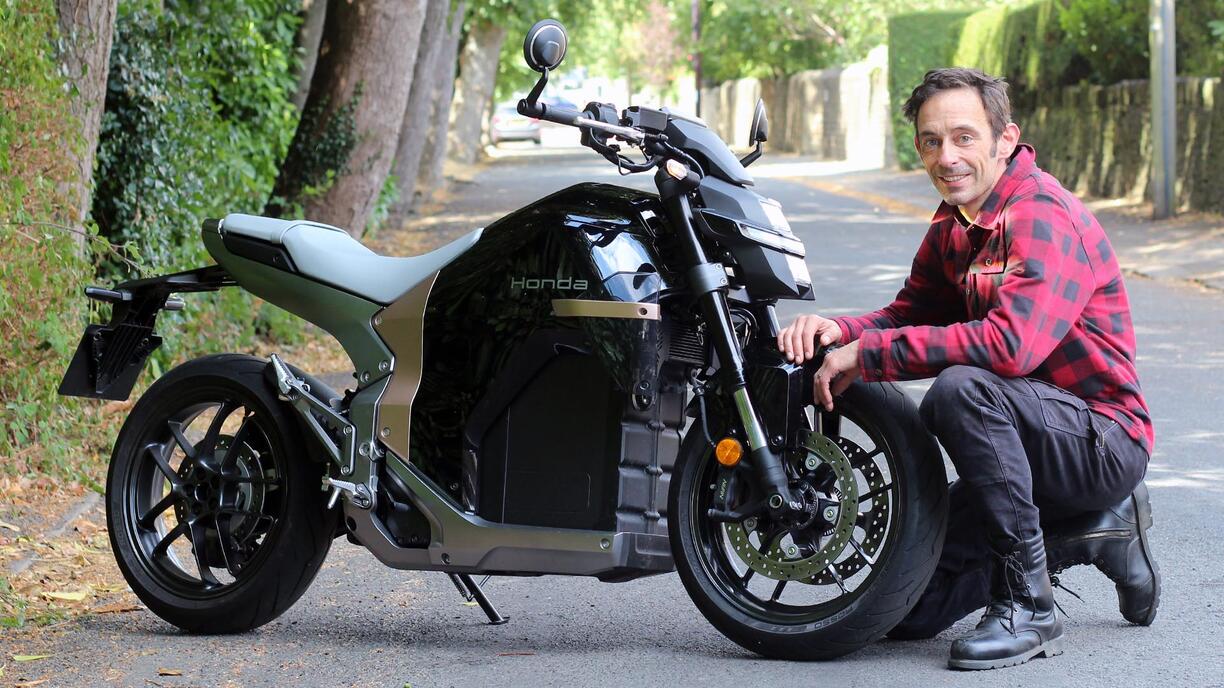
Whether or not the WN7 sells in big numbers it’s undoubtedly one of the more significant Honda motorcycles of recent times, and a major evolutionary step for electric bikes. True, it is very expensive when compared to equivalent combustion-powered bikes. But the addition of car-style rapid charging stands out among all the other electric bikes on the market, and makes it much more viable as daily transport. For A2 and even A1 riders it’s also a lot faster, smoother and more powerful than anything else you can ride on a restricted licence, and combines big-bike pace and poise with accessible size and tech.
“The clever ‘frameless’ construction uses the massive battery pack at its centre as a stressed member”
A headlight shaped like the helmet of some sort of attack robot sets the tone for the WN7’s styling, which from here on back embraces the futuristic engineering beneath while still looking recognisably like what we understand to be a motorcycle. The clever ‘frameless’ construction uses the massive battery pack as a stressed member to which an aluminium headstock and rear subframe containing the motor and rear suspension mounts attach. The forks and single-sided swingarm are a little more conventional and there are lots of clever touches blending form with function, these including side blades used to channel cooling air over the 9.3kWh battery pack. Bar-end mirrors add a dash of hipster cool to the package, the slightly skinny looking rear tyre the only real aesthetic downer.
Expert rating: 5/5
Riding position
“For all the futuristic looks it is, at heart, a traditional roadster riding position”
For a bike you can buy and ride in A1 form with nothing more than a CBT and L-plates the WN7 presents as a proper full-size motorcycle. In full-power form it’s more akin to a A2 licence bike or scooter, the relatively stretched riding position proving roomy on the move while the incredibly slim frame makes it friendly and easy to flat foot at low speeds. For all the futuristic looks it is, at heart, a traditional roadster riding position, with a nice balance between sportiness and upright convenience. Mid position pegs meanwhile mean you can actually get it round corners at a reasonable lick without grounding it out as we did the similarly electric powered VMoto Stash.
Expert rating: 4/5
Practicality
“There is a pillion seat and footpegs for a passenger, but it looks pretty minimal back there”
The WN7 is a relatively minimalist bike, with little in the way of creature comforts or protection from the elements. Given it’s more suited to urban use and short blasts than extended long-distance cruising that’s absolutely fine, though. Our test bike came with an accessory soft tailpack sufficient for carrying a lock, waterproofs and change of clothes for the commute but not much else. There is a pillion seat and footpegs for a passenger, but it looks pretty minimal back there. Range is, of course, an important element of practicality on an electric bike and Honda’s claimed 87 miles looks optimistic against the 60-plus we’d have achieved if we’d kept going the way we did on the fast-paced test ride. You’d likely get closer to the official figure in town use, mind. Charging is the WN7’s trump card, though, the CCS connector compatible with public electric car charging stations and capable of topping up from 20 to 80 per cent in just 30 minutes without needing to carry your charger or cable with you. In terms of speed and convenience this is a genuine game-changer for electric bikes.
Expert rating: 3/5
Performance & braking
“You also have three regenerative modes, which act like engine braking and help put some juice back in the battery”
While the WN7’s peak 68 horsepower is way over the limit for an A2 bike the continuous output of 24 horsepower means it’s still compliant with a restricted licence, which is a nice bonus of electric bikes. The more significant figure is the 100Nm of instant torque, which is still present on the 15 horsepower A1 licence version! Honda’s experience with electric cars and its characteristic engineering rigour means the throttle has been properly calibrated to minimise tyre torturing wheelspin or inadvertent wheelies, though we still got some interventions from the traction control at relatively modest speeds. Around town you’ll want to stick to the more relaxed ECON or Rain modes, the response in Standard or Sport enough to have your eyes on stalks the first time you crack the throttle. While acceleration up to 60mph or so is way more rapid than any equivalent combustion-engined bike beyond that the pace tails off quite dramatically, though motorway cruising remains well within reach.
At 217kg the WN7 is hefty for a bike of this size, but that’s been turned into a virtue for effortless off-throttle coasting, and can be used to your advantage when slowing down under regenerative braking to put juice back into the battery, which can make a big difference to your range. You can leave this in the auto mode or control it ‘manually’ as you might a DCT gearbox, increasing the regen in steps as you approach a corner or traffic lights like going down through the gears. This is both efficient and gives you something to do but can be alarming if you leave it in minimum regen and arrive at a corner with no engine braking, at which point you’ll be glad of the twin-disc Nissins up front!
Expert rating: 4/5
Ride & handling
“You learn to adapt and adjust your riding style accordingly, leaning on the smooth and silent electrified grunt on corner exit”
You feel the extra weight of the WN7, though the mechanical layout puts it low down in the bike for a very stable centre of gravity. Perhaps a little too stable at times, the steering response sometimes feeling more like a cruiser than a roadster at times. You learn to adapt and adjust your riding style accordingly, leaning on the smooth and silent electrified grunt on corner exit to enjoy a slow-in, fast-out rhythm through the bends. Overall, though, the WN7 is very easy and confidence-inspiring to ride, the option to manually adjust the regen meaning there’s more to the riding experience than simple twist-and-go, should you wish it.
Expert rating: 3/5
Running costs
“The belt drive and relative mechanical simplicity of the electric powertrain should also be cheaper to keep running”
The need to rationalise a high purchase price against low running costs is a reality shared with all electric vehicles, though potentially a new one for motorcyclists to understand. But it’s impossible to ignore how expensive the WN7 looks up front, even if it’s actually mid-pack among rivals like the CanAm Pulse and Livewire S2 Alpinista we ran on extended test. If Honda can offer some competitive monthly PCP rates that will help make it look a little more viable, and once up and running ‘fuel’ will be cheap as chips, a full charge on even a regular domestic electricity tariff costing a couple of quid with the potential to bring that down to mere pence with a dedicated off-peak EV domestic energy plan. The belt drive and relative mechanical simplicity of the electric powertrain should also be cheaper to keep running than an equivalent combustion bike, too.
Expert rating: 4/5
Reliability
“We’ll just have to hope the brand’s reputation for reliability is as good in the electronic age”
Seemingly there’s very little that could go wrong on the WN7, given the cycle parts like suspension and brakes are proven kit from Showa, Nissin and the like, the battery and motor have little in the way of moving parts and drive to the rear wheel is via a belt. It’s also a Honda, of course! We’ll just have to hope the brand’s reputation for reliability is as good in the electronic age as it has traditionally been in the mechanical one.
Expert rating: 5/5
Warranty & servicing
“Honda’s standard warranty is now up to six years if you commit to servicing at authorised agents”
At the time of writing even Honda seemed a little uncertain of the service intervals for the WN7, given it’s not like it needs oil changes, valve checks, new chains or any of the upkeep required of combustion bikes. It still needs the usual first ‘break in’ check at around 600 miles as normal, beyond which it follows a similar regime to combustion bikes with checks every 8,000 miles or annually. Meanwhile, Honda’s standard warranty is now up to six years if you commit to servicing at authorised agents.
Expert rating: 4/5
Equipment
“A selectable speed limiter is also a neat touch, and likely welcome in towns and cities”
While fundamentally minimalist in its vibe the WN7 is impressively well-specced when it comes to tech. Along with the four riding modes and three regenerative braking settings there’s Honda’s HSTC traction control and lean-sensitive ABS, your main point of contact being through the familiar TFT screen and logical control pad on the left switch cube used across the firm’s mid-size bikes. This is also connectable to your phone via the Honda RoadSync app, should you so wish. A smart key and heated grips are also standard and there are some unusual features, like a reverse gear and ‘walk’ mode for off-bike manoeuvring. A selectable speed limiter is also a neat touch, and likely welcome in towns and cities where the punchy acceleration and lack of engine noise could easily see you blasting through limits without even realising.
Expert rating: 4/5
Why buy?
“As an overall package it more than lives up to the expectations the Honda badge brings”
At this price the WN7 is unlikely to win many converts from conventional combustion bikes, unless it’s joining an existing fleet as a smooth and silent urban runabout or stylish commuter. For young riders on A1 or A2 licences it may well be a different story, the significant increases in performance over what they might otherwise ride as attractive as the cool, futuristic looks. As an overall package it more than lives up to the expectations the Honda badge brings, and as the first mass-market electric motorcycle from a mainstream manufacturer it’s an important moment for powered two-wheelers that deserves recognition. It’ll be interesting to see how the rest of the industry reacts.