Feature
Dacia Duster Cargo vs Volkswagen ID.Buzz Cargo
In the latest van head-to-head, we put the Dacia Duster Cargo against the Volkswagen ID.Buzz Cargo and see how they stack up

Words by: Tom Roberts
Published on 5 May 2026 | 0 min read
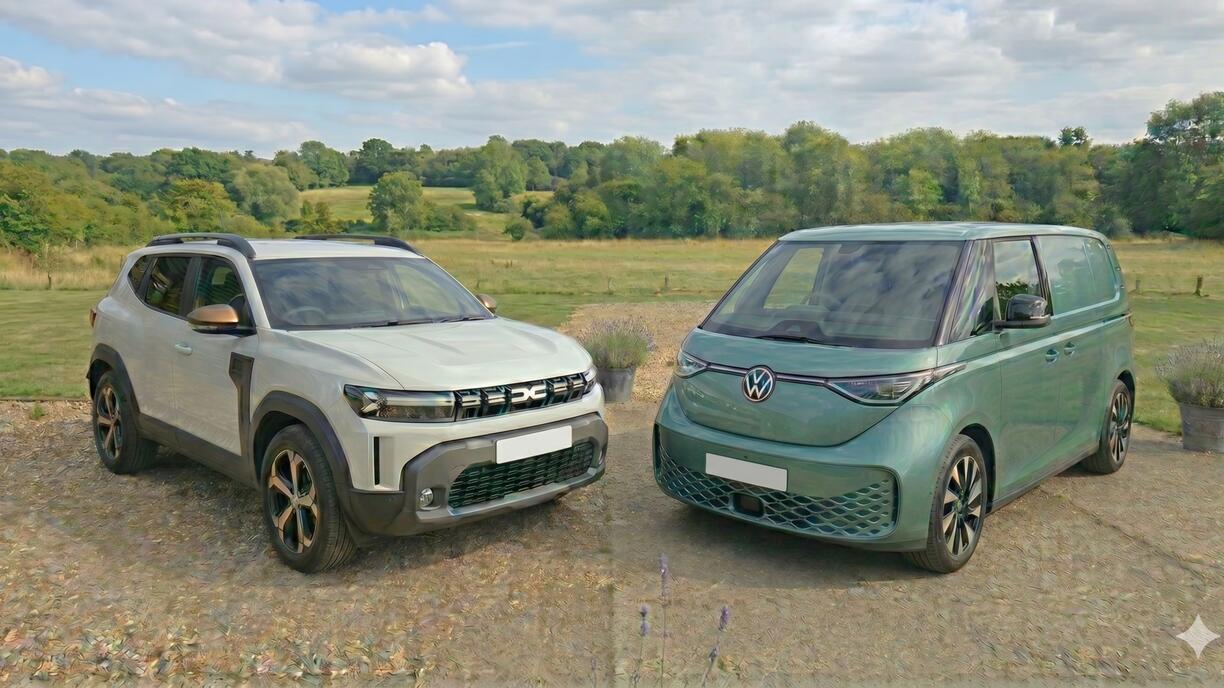
There are so many car-derived vans available right now that this niche end of the market feels swamped with choice. So, to spice things up (a bit) we decided to put two car-derived vans head to head, and what better subjects than the new Dacia Duster Cargo and the latest Volkswagen ID.Buzz Cargo? One sits at the affordable end of the market and the other very much not, one might feel like a compromise while the other an aspirational choice… this should be interesting.
| Volkswagen ID.Buzz Cargo | Dacia Duster Cargo | |
|---|---|---|
| Starting price (ex VAT) | ~£36,000 | ~£24,000 |
| Payload (maximum) | 710 kg | 430 kg |
| Load volume | 3.9 cubic metres | 1.14 cubic metres |
| Fuel type | Electric | Mild/full hybrid, petrol |
| Range (maximum) | ~270 miles | ~500 miles plus |
Body types


Both vans are available in one body type each. The Duster Cargo is a simple car-derived van conversion – remove back seats, level off, add a bulkhead, job done – all contained within the car’s standard body. The ID.Buzz Cargo is a classic panel van available in a single short-wheelbase version. Despite the differences in size, the playing field is pretty level between these two in this category. Or is it?
Well, let's look at a constant 'living with' issue like entering a multi-story car park. The ID.Buzz Cargo is just over 1.9 metres tall, which makes it a bit of a tight squeeze under some car park height restriction bars... the Duster Cargo is just 1.6m tall and will sail under them. Can a Duster Cargo fit a Euro-pallet in its load space? No, it can't, but the ID.Buzz Cargo can fit two Euro-pallets in the back. One can go anywhere in the urban setting, while the other can carry more almost everywhere.
Well, let's look at a constant 'living with' issue like entering a multi-story car park. The ID.Buzz Cargo is just over 1.9 metres tall, which makes it a bit of a tight squeeze under some car park height restriction bars... the Duster Cargo is just 1.6m tall and will sail under them. Can a Duster Cargo fit a Euro-pallet in its load space? No, it can't, but the ID.Buzz Cargo can fit two Euro-pallets in the back. One can go anywhere in the urban setting, while the other can carry more almost everywhere.
Engines / Powertrains


The ID.Buzz is an electric van, with no other options in this category besides battery size – a 59 kWh pack offering between 200-270 miles of range and a 79 kWh pack offering 277-384 miles… depending on how you drive it. The Duster Cargo, meanwhile, is available with a choice of two electrified petrol engines, one is a full hybrid powertrain and the other is a mild hybrid version coupled with 4x4 transmission for all-terrain driving. The Duster Cargo we had in for review was a two-wheel-drive full hybrid version offering up to 500 miles of range.
Is there a winner here? Depends on your criteria. The Duster Cargo can drive way further and is frugal with its petrol usage, while the ID.Buzz Cargo’s all-electric range is very reliable and higher than many other small panel vans. We’re big fans of electric vans that achieve their stated ranges, but we were very impressed with the Duster Cargo’s ability to switch from electric to petrol power so efficiently.
Is there a winner here? Depends on your criteria. The Duster Cargo can drive way further and is frugal with its petrol usage, while the ID.Buzz Cargo’s all-electric range is very reliable and higher than many other small panel vans. We’re big fans of electric vans that achieve their stated ranges, but we were very impressed with the Duster Cargo’s ability to switch from electric to petrol power so efficiently.
Payloads and cargo space


The smaller car-derived Duster Cargo’s load space is just over one cubic metre in size, while the ID.Buzz Cargo’s load volume is 3.9 cubic metres. Payloads sit between 600-700 kg for the ID.Buzz and up to 450 kg in the Duster Cargo. In a simple on-paper comparison, the Buzz wins, offering more space and being capable of carrying more weight.
Cabins and trim levels


The Duster Cargo’s cabin is a car interior with two front seats, available in one well-equipped trim level. Equipment highlights include 17-inch alloy wheels, roof bars, seven-inch driver display, 10.1-inch infotainment screen with all nav and connectivity, air con and more. It’s a comfortable space to spend time although the low roof combined with blacked-out second windows and a small rear window make it quite dark inside… and pretty scary to drive at night because your blind spots are almost completely obscured. The safety equipment fitted to the Duster Cargo is comprehensive, however, with a rear-view camera, full sensor package, lane keep assist, emergency braking, hill start assist and much more.
On the other van, the ID.Buzz Cargo’s spacious interior is open and well lit with excellent visibility, a comfortable driving position and seats for three people. While the cabin boasts high build quality and clever design touches, the touch-sensitive steering wheel and un-angled 12.9-inch infotainment screen can be annoying to use. Despite the lack of physical buttons, connectivity is plentiful and storage is decent. Given the minimal internal upgrades in higher trims, the well-equipped base Commerce model is easy to recommend. Personal taste will make the biggest play here, depending on whether you prefer a car or van cabin.
On the other van, the ID.Buzz Cargo’s spacious interior is open and well lit with excellent visibility, a comfortable driving position and seats for three people. While the cabin boasts high build quality and clever design touches, the touch-sensitive steering wheel and un-angled 12.9-inch infotainment screen can be annoying to use. Despite the lack of physical buttons, connectivity is plentiful and storage is decent. Given the minimal internal upgrades in higher trims, the well-equipped base Commerce model is easy to recommend. Personal taste will make the biggest play here, depending on whether you prefer a car or van cabin.
Pricing


We know this is probably the key area of difference between these two commercial vehicles. The Duster Cargo’s starting price is a competitive £23,595 (ex VAT) for the full hybrid version we tested, while on the other hand an ID.Buzz Cargo starts at around £36K (ex VAT). It’s not an insignificant jump in price between the vans, and we’ll be the first to say that you’ll feel the difference in the monthly payments if you get one on a lease deal. It’s fair to say that you get what you pay for with the ID.Buzz Cargo, but if you’re looking for something smaller and more cost-effective right now then the Duster Cargo will win every time.
Conclusions


So, how do we finish this one? Well, the ID.Buzz Cargo’s nostalgic looks, clean cabin, 300-mile range and 600-700 kg payload make it a decent small electric van on paper, but one that is beaten on price and practicality by other electric vans in its class. The Duster Cargo, meanwhile, boasts a far more competitive price and full hybrid range of well over 500 miles against a sub-500 kg payload and the whole ‘car-but-not-a-car’ vibe on the inside. Ultimately, the choice between a ‘normal’ panel van and car-derived van comes down to how it’s going to be used.
As a final thought, we’re not going to shy away from the fact we gave the ID.Buzz Cargo a four-star review, nor that we gave the Duster Cargo 0.25 of a star less – there’s something about how the ID.Buzz looks and feels to drive that makes it the more desirable vehicle. But desirability isn’t often THE key factor when it comes to choosing your next commercial vehicle. Not for nothing, but maybe Dacia should have a think about turning the Jogger into its next car-derived van, we’re big fans. In the end, we always recommend choosing with logic – how you’ll use the vehicle and what you need from it – but we totally understand sometimes going with your heart.
As a final thought, we’re not going to shy away from the fact we gave the ID.Buzz Cargo a four-star review, nor that we gave the Duster Cargo 0.25 of a star less – there’s something about how the ID.Buzz looks and feels to drive that makes it the more desirable vehicle. But desirability isn’t often THE key factor when it comes to choosing your next commercial vehicle. Not for nothing, but maybe Dacia should have a think about turning the Jogger into its next car-derived van, we’re big fans. In the end, we always recommend choosing with logic – how you’ll use the vehicle and what you need from it – but we totally understand sometimes going with your heart.
Did you find this article interesting?
If you enjoyed this article and want to read more like it, head to our vans content section and check out our huge range of reviews, news, guides and advice articles.