Best of
The top 10 Ducatis – ever!
2026 marks the Italian marque’s centenary – but what have been its 10 best bikes over that time…?

Ducati is arguably the most desirable biking brand of all and this year marks its 100th anniversary which got us thinking…
Just how did the legendary Italian marque get to this point? And which have been its milestone motorcycles along the way? So, from Ducati’s oldest (and smallest), to its latest and most sophisticated, with a few classics along the way, here are our ‘Top 10 Ducatis – ever’ and what made them so special, unless, of course, you disagree…!
Just how did the legendary Italian marque get to this point? And which have been its milestone motorcycles along the way? So, from Ducati’s oldest (and smallest), to its latest and most sophisticated, with a few classics along the way, here are our ‘Top 10 Ducatis – ever’ and what made them so special, unless, of course, you disagree…!
1 | 1946 Ducati Cucciolo

Ducati’s first step into motorcycling … wasn’t a complete motorcycle at all! Launched in 1926, the Ducati company, founded by four brothers, was an electrical and radio concern. As a wartime components supplier, Ducati’s Borgo Panigale factory in Bologna was destroyed by American bombing. This gave Ducati an opportunity to ‘re-invent’ itself. To fulfil the need for affordable post-war transport, Ducati developed an auxiliary engine which could be fitted to bicycles. The 49cc ‘Cucciolo’ (Italian for puppy) was the result, proved a huge success, transformed Ducati as a company and was quickly followed by more complete machines.
2 | 1962-on Ducati Scrambler 250/350/450

After substantial growth as a lightweight machine specialist, Ducati developed its first ‘Scrambler’ in the early 60s. Initially a 250 single, it became a huge hit in America appealing to the ‘desert sled’ generation. The Scramblers stood out for their Italian style, bold yellow and orange colour schemes and fun, easy manners. From 1967 the second-generation machines grew to 350 then 450cc, spawned roadster and even cafe racer variants and later inspired Ducati’s modern, entry-level Scrambler family as launched in 2015.
Read our review of the latest Ducati Scrambler here
Read our review of the latest Ducati Scrambler here
3 | 1971 Ducati 750 GT

Many think the later Supersport was Ducati’s first V-twin – it wasn’t. A new breed of 750cc multicylinder superbikes like Honda’s 1968 CB750 and Triumph’s Trident, along with the newly created 750cc Formula One racing class prompted Ducati to follow suit. A new ‘L-twin’ 90-degree bevel-drive V-twin engine was designed by Fabio Taglioni based on the Scrambler single. Intended as a grand sports tourer, the 750 GT went into production in 1971 and immediately won fans for its handling and performance. The sportier 750 Sport soon followed, then the Desmo 750 Super Sport (below with all three honoured by Ducati’s later, 2005 Sport Classic family) and the era of Ducati V-twins had begun…
4 | 1973 Ducati 750 Super Sport

One of the first sporting highlights of the new Formula One 750cc racing class was the Imola 200 race. Most of the leading manufacturers took part with racers based on modified road machines and Ducati was among them. The 750 was based on the 750 GT but with the desmodromic heads from its then 500cc GP racer. Brit Paul Smart was drafted in as a late additional rider, won, heroically, ahead of team leader Bruno Spagiarri and a legend was born.
The following year, a road going replica, the 750 Super Sport Desmo was presented at the Milan Show. It instantly became one of the most desirable superbikes of all and Ducati’s success through the rest of the 70s with a series of V-twin superbikes was all but assured. Today, the 750 Super Sport Desmo remains arguably the most desirable Ducati classic of all…
The following year, a road going replica, the 750 Super Sport Desmo was presented at the Milan Show. It instantly became one of the most desirable superbikes of all and Ducati’s success through the rest of the 70s with a series of V-twin superbikes was all but assured. Today, the 750 Super Sport Desmo remains arguably the most desirable Ducati classic of all…
5 | 1979 Ducati SL500 Pantah

By the late 1970s, despite the fillip provided by Mike Hailwood’s fairytale victory in the 1978 TT F1 race, Ducati’s superbikes looked old and expensive, plus they were outpaced by the latest bikes from Japan. The 1979 SL500 was the response. A middleweight V-twin with a rubber timing belt rather than bevel gear system and new trellis frame became another Ducati signature. The Pantah was brisk, characterful and, although no superbike-beater, good enough to dominate F2 class racing. It also formed the basis of a series of larger machines, including the 750 F1, which, in the late 1980s, after Cagiva’s takeover, clawed Ducati back to credibility leading up to the 851.
6 | 1988 Ducati 851 Tricolore

The superbike with which Ducati truly re-entered the modern age. After Ducati’s takeover by ambitious Cagiva, Taglioni’s retirement and the emergence of a new generation of designers like Massimo Bordi, focus soon switched towards developing an all-new Ducati superbike. At its heart would be the liquid-cooled, four-valve ‘Desmoquattro’ engine developed by Bordi out of the belt drive Pantah. The frame was the now signature tubular steel trellis, and the result was the 851, first launched as the road going Tricolore. In truth, though revolutionary, success wasn’t immediate, but in 1990 it won its first world superbikes crown. Its successor, the larger 888 repeated the feat in 1991 and 1992, and Ducati’s superbike ‘mojo’ was back.
Find a Ducati 851 on Autotrader
Find a Ducati 851 on Autotrader
7 | 1993 Ducati M900 Monster

The 851 may have been a race winner but it was not the volume street seller Ducati needed in the early 1990s. For that it came up with, first, the 750/900 Supersports then, the first Monster naked roadster. The pet project of then junior designer Miguel Galluzzi was a bare bones roadster developed under his mantra of “All you need is: saddle, tank, engine, two wheels and handlebars”. It was effectively a ‘parts-bin’ special, using the Supersports 900 aircooled engine, the 851’s chassis, front end from the 750 Supersports and so on. But the style, appeal, ease of production and success of the Monster was all its own. An immediate hit it quickly spawned a 600 sibling followed by many others. Today, the Monster is Ducati’s longest lived (and arguably most important) model family of all.
Read our review of the Ducati Monster 937 Naked
Read our review of the Ducati Monster 937 Naked
8 | 1994 Ducati 916

The successor to the 851/888 superbike, the hugely successful, stunningly gorgeous and multiple award-winning 916 is arguably the most famous Ducati of all. Based on the 888 but more powerful, lighter, racier and styled by Massimo Tamburini to include distinctive underseat exhausts and a single-sided swing arm. The 916 simply had it all – speed, good looks, exclusivity and credibility – enough to make it a poster bike for a generation. It also went on to win six WSB crowns and made a superstar of Brit Carl Fogarty.
Find a Ducati 916 on Autotrader
Find a Ducati 916 on Autotrader
9 | 2006 Ducati Desmosedici RR

The late 80s and 90s saw Ducati rise to world superbike success and the 2000s saw it return to grand prix under the new four-stroke MotoGP formula with the V4 Desmosedici debuting in 2003, winning its first race later that year. The following year, Ducati CEO Federico Minoli announced the brand would go even further and produce a street version. The astonishing, road legal Desmosedici RR was the result and was the world’s first true ‘MotoGP replica’. With over 200bhp, one of the most extreme experiences in motorcycling and just 1,500 built, the Desmosedici RR remains one of the most astonishing and desirable Ducatis of all.
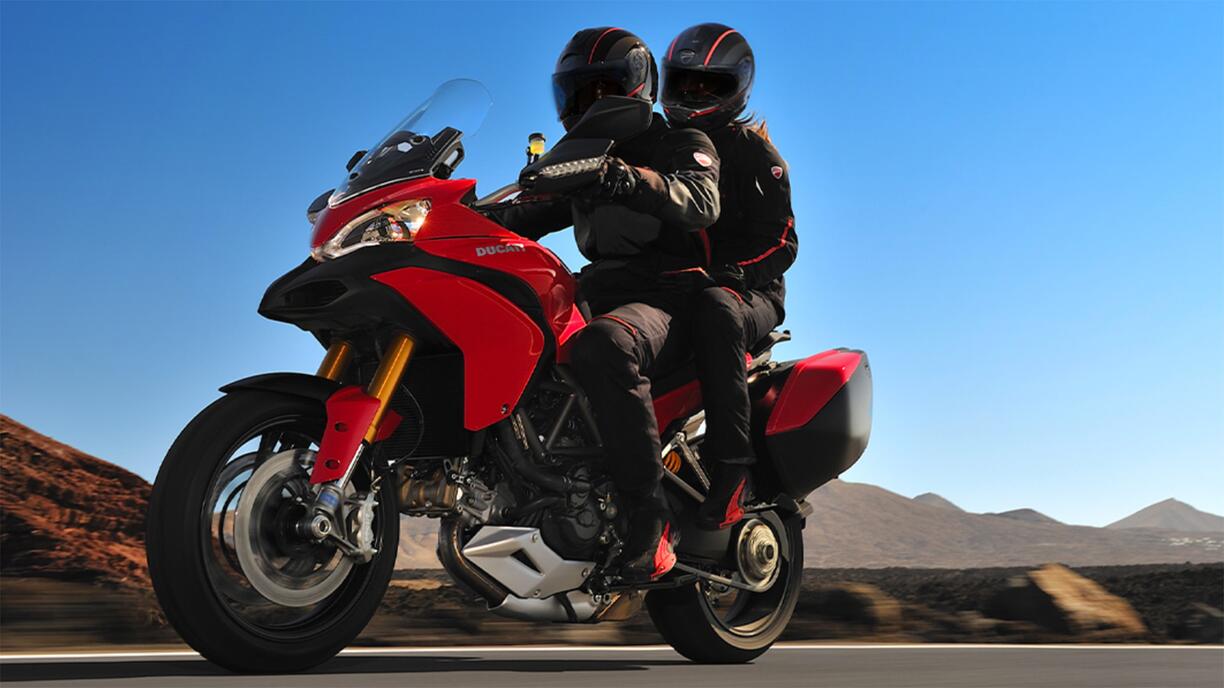
10 | 2012 Ducati Multistrada 1200 S

Much more than a mere updated successor to the original 2003 air-cooled Multistrada, the second generation ‘Strada has proved one of Ducati’s most successful models of recent times. It redefined versatility via the pioneering introduction of its riding modes systems which altered engine and suspension characteristics at the push of a button to suit ‘Sport’, ‘Tour’, Urban’ or ‘Rain’ requirements – a concept which has since been adopted industry-wide.
On top of that, the Multistrada had the 150bhp Testastretta engine from the 1098 Superbike, fabulous handling, excellent comfort and lots of comfort and options – no wonder it’s been so successful. Repeated updates culminated in 2021’s equally revolutionary Multistrada V4 (now with radar-assisted riding aids and more) and today the Multistrada is arguably Ducati’s best-selling, most sophisticated model of all. Not bad for a company that started out making 50cc engines… Find a Ducati Multistrada on Autotrader Read our review of the latest Ducati Multistrada here
On top of that, the Multistrada had the 150bhp Testastretta engine from the 1098 Superbike, fabulous handling, excellent comfort and lots of comfort and options – no wonder it’s been so successful. Repeated updates culminated in 2021’s equally revolutionary Multistrada V4 (now with radar-assisted riding aids and more) and today the Multistrada is arguably Ducati’s best-selling, most sophisticated model of all. Not bad for a company that started out making 50cc engines… Find a Ducati Multistrada on Autotrader Read our review of the latest Ducati Multistrada here