News
Everything we know about the Volkswagen ID.Buzz Autonomous Driving
We got up close and personal with the Volkswagen ID.Buzz Autonomous Driving in Hanover. Here’s everything we know about it

Words by: Tom Roberts
Published on 12 March 2026 | 0 min read
On our trip to Volkswagen’s Hanover manufacturing plan to celebrate its 70th anniversary, we were given access to see the new ID.Buzz Autonomous Driving (AD) van being built. Right now, the company is building and testing the new model in pre-production ahead of ramping up to full production in 2027.
What we saw of the ID.Buzz AD

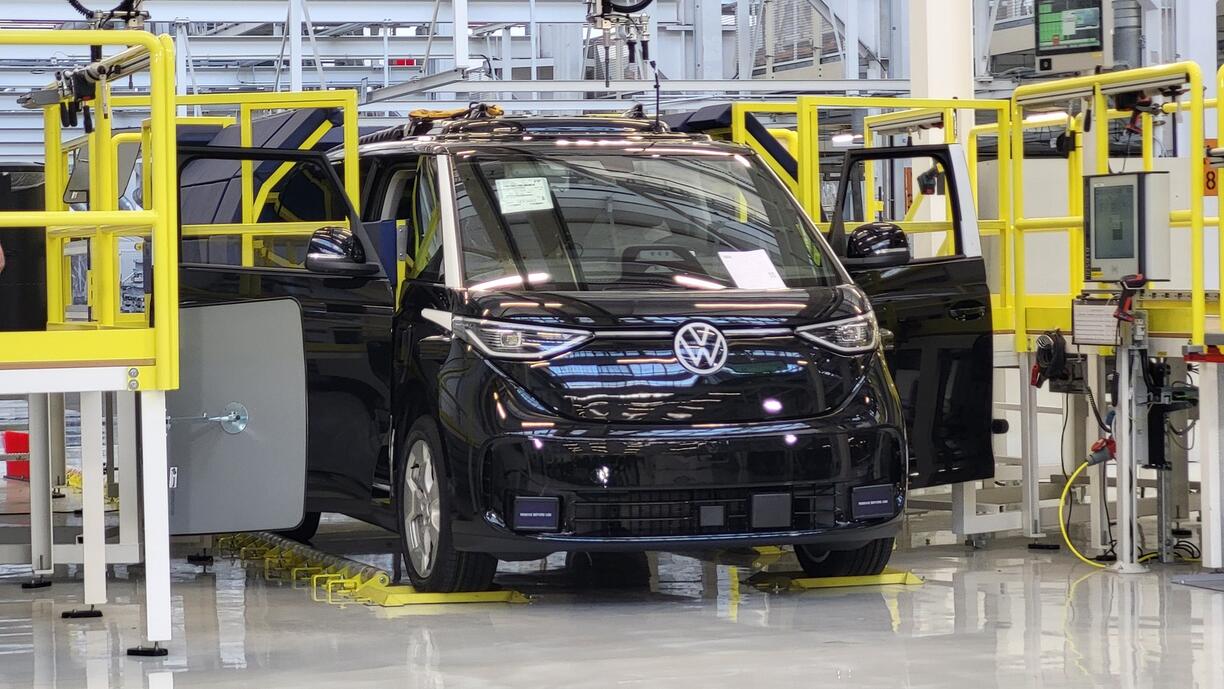
The ID.Buzz AD was hard to miss as it was the backdrop to the presentation area us journos were herded into at Volkswagen’s Hanover manufacturing facility. Decked out in a cool piano black job, at first glance it looked like a regular ID.Buzz MPV. Looking closer, we noticed the sensor deck (more on that later in the article) on the roof and the 360-degree cameras and sensors mounted on the front, back and sides. This model was used to demonstrate how the roof-mounted sensor deck was installed by hand.
Later in the day we were ushered to an area behind where we were seated to see another ID.Buzz AD in a calibration suite. This model was surrounded with black and white checkerboard panels positioned at key places around the vehicle. These panels are used to calibrate the camera and sensors that feed situational awareness data into the vehicle’s computer. Inside we saw reams of cables hooked up to the AD’s information screens and two technicians checking data feeds. We noticed that it’s the long wheelbase ID.Buzz being used to make the ADs. The LWB provides a bigger battery pack for better range and power output, and because the LWB provides more space to fit an underfloor-mounted water tank used to spray the external camera/sensor modules and keep them clean. The ID.Buzz is already a good-looking vehicle and the external camera/sensor mounts add a futuristic edge. We think Volkswagen has done a good job keeping the base van’s nostalgic looks intact while augmenting them with the autonomous driving technology. More details are included below.
Later in the day we were ushered to an area behind where we were seated to see another ID.Buzz AD in a calibration suite. This model was surrounded with black and white checkerboard panels positioned at key places around the vehicle. These panels are used to calibrate the camera and sensors that feed situational awareness data into the vehicle’s computer. Inside we saw reams of cables hooked up to the AD’s information screens and two technicians checking data feeds. We noticed that it’s the long wheelbase ID.Buzz being used to make the ADs. The LWB provides a bigger battery pack for better range and power output, and because the LWB provides more space to fit an underfloor-mounted water tank used to spray the external camera/sensor modules and keep them clean. The ID.Buzz is already a good-looking vehicle and the external camera/sensor mounts add a futuristic edge. We think Volkswagen has done a good job keeping the base van’s nostalgic looks intact while augmenting them with the autonomous driving technology. More details are included below.
Where is the ID.Buzz AD being built?

Pre-production of the fully autonomous ID. Buzz is already underway at Volkswagen’s Hanover manufacturing plant. The van passes through the same production sections of the factory as all non-autonomous ID.Buzz MPVs, with an additional production loop being used for installation of its specific components.
What special components does the ID.Buzz AD use?

The ID.Buzz AD’s special components include the combined roof module with cameras, radar and lidar units (mounted on a redesigned roof panel), and the computer on the front passenger side. The end of the process sees the vehicle undergo sensor calibration and final commissioning before it rolls off the production line. The result is an SAE Level 4 vehicle that can drive fully autonomously (in defined areas) as a shuttle vehicle, a robo taxi or for ride-pooling services.

How many ID.Buzz ADs will be built?

Through 2026, pre-production of the ID.Buzz AD at the Hanover plant will be ramped up to around 500 vehicles, with those vehicles already planned for use in various projects in Europe and the USA. Full production will begin in 2027 with 100,000 set to be on the road by 2033.

Who makes the ID.Buzz AD?

The ID.Buzz AD is made by Volkswagen Commercial Vehicles (VWCV) and its subsidiary Moia. The two companies have been working on this autonomous version of ID.Buzz for quite a few years with plans for it to be used as a robotaxi or in autonomous shuttle services. In June 2025, the companies jointly announced that the ID.Buzz AD was ready for production, which was 100 per cent confirmed when we saw it up close in Hanover.

How will ID.Buzz ADs be sold?

Moia will offer the ID.Buzz AD as part of a package that includes the vehicles and their autonomous driving systems, alongside some fleet management software and ‘operator services’ for companies looking to provide autonomous driving services in cities.

Did you enjoy this article?
If you enjoyed this article, head to our vans content section and check out our huge range of reviews, news, guides and advice articles.