Ford E-Transit Custom vs Volkswagen e-Transporter
In the latest van head-to-head, we put the Ford E-Transit Custom against the Volkswagen e-Transporter in a clash of VERY similar electric titans

Words by: Tom Roberts
Published on 12 May 2026 | 0 min read
Comparing the Ford E-Transit Custom and Volkswagen e-Transporter electric vans in 2026 is the ultimate ‘identity crisis clash’, as once upon a time these two commercial vehicles were bitter rivals built on unique platforms. That’s not the case anymore, and immediately provokes the question: “Is the Volkswagen Transporter just a Ford Transit Custom with a different badge?” Well… they’re both built on a Ford-developed platform, so it would be easy to dismiss it as such, but there are differences. They’re just less obvious than before, and to prove it have a quick look at the vital statistics of price, payload, range and warranty in table form:
Ford E-Transit Custom | Volkswagen E-Transporter | |
|---|---|---|
Starting price (ex VAT) | ~£38,600 | ~£38,200 |
Range (maximum) | ~230 miles | ~225 miles |
Payload (maximum) | ~1,135 kg | ~1,092 kg |
Load volume (maximum) | Up to 9.0 cubic metres | Up to 9.0 cubic metres |
Vehicle warranty | Three years / 100,000 miles | Five years / 124,000 miles |
Battery warranty | Eight years / 100,000 miles | Eight years / 100,000 miles |
As you can see, there’s a lot of overlap in practicality and price, although it’s easy to spot the higher five-year warranty in Volkswagen's column. That package, the 5+ Promise, is the jewel in Volksagen's crown and includes five years of breakdown cover, three MOTs and services. And while we have seen the warranty package turn some heads to the Volkswagen, it doesn’t stop the Ford Transit Custom from continuing to outsell every van in the UK by a substantial amount. However, tables like this do obscure the more subtle differences between vans that platform share, so let’s get into them.


Body types
Both vans are available in standard panel and crew cab body types (double cab-in-van or kombi), with both also available in multi-seat formats. Long/short wheelbases and high/low roof options can be chosen on both vans, with the longest and highest bodies bringing the maximum ranges and payloads down slightly.
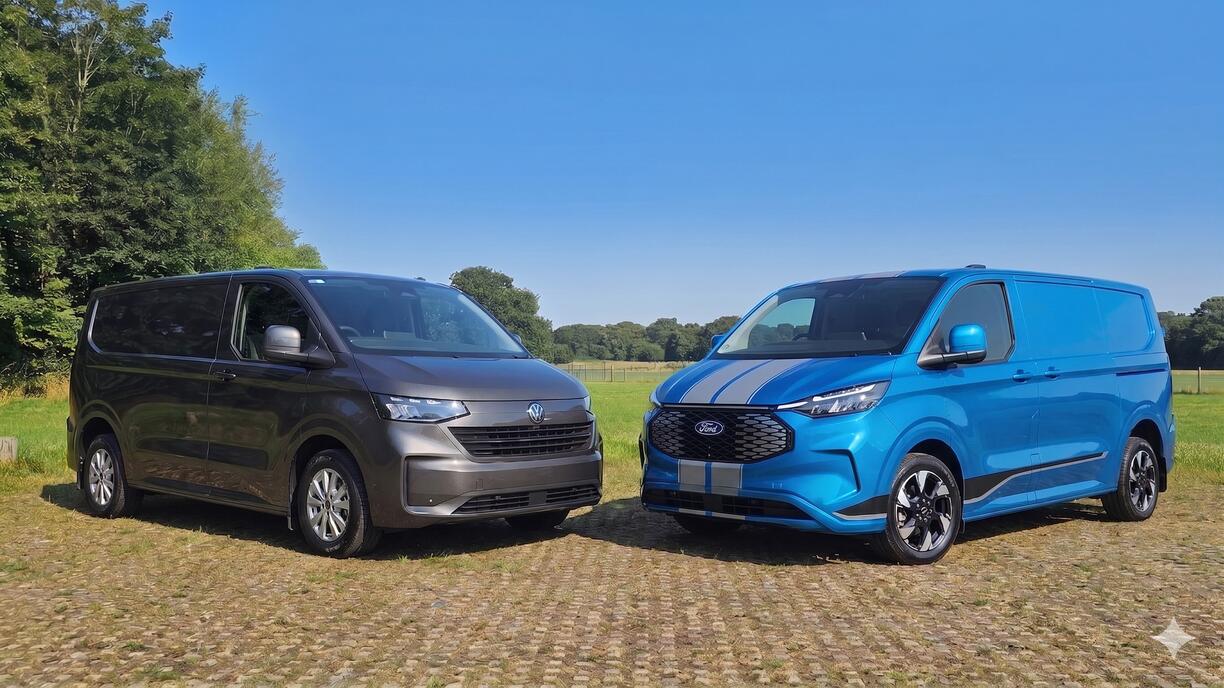
The most obvious difference between the vans is how they look, and we don’t just mean the badges. The Ford E-Transit Custom has a more angular shark-like look with a big grille and sporty thin headlights, while the Volkswagen e-Transporter is rounder with a more snub-nosed slope to a thin grille and thicker headlights. Personal taste plays a big role in a van’s look, with both offering something very different on the outside.
One could argue (at a push) that the smoother front end of the e-Transporter might give it a more aerodynamic quality, but we wouldn’t stake our reputations on it. It’s worth adding that top-spec versions of each van are available with Ford offering an MS-RT version of the Custom and Volkswagen set to launch a Sportline version of the Transporter. The winner here is purely down to taste.


Engines / Powertrains
Both vans use the same single rear-mounted electric motor available in a variety of power outputs, with the top-spec MS-RT and Sportline models getting the highest. The 65 kWh battery packs provide over 200 miles of range… although this will depend on how you drive it, how much load you’re carrying, the weather conditions, ambient temperature, the power output and vehicle size you choose, etc. But look, these are solid electric vans and no matter which configuration or body type you choose you’re getting a decent range from a modern shared electric powertrain.


Payloads and cargo space
Being based on the same platform means cargo space and payloads are relatively similar. The Ford E-Transit Custom edges out the e-Transporter by a handful of kgs, so it’s the winner on paper. But with both capable of carrying over one tonne it’s a close call if a few more kgs makes a big enough difference to choose one over the other. Load volumes are consistent across vans and body types, ranging up to 9.0 cubic metres in the long wheelbase/high-roof L2H2 panel versions of each van. Both vans can tow up to 2,300 kg, although this does depend on which model you choose with some variants only capable of towing 1,000 kg – in the Volkswagen it breaks down like this: Shuttle models can tow 1,000 kg, the Kombis 2,000 kg and Panels 2,300 kg.


Cabins and trim levels
The Ford E-Transit Custom is offered in four trim levels – Trend, Limited, Sport and top-spec MS-RT – while the Volkswagen e-Transporter is offered in three – Commerce Plus, Commerce Pro and top-spec Sportline, with each trim building on the last with equipment or styling-based gains. The Ford’s cabin feels bigger and more durable, while the Volkswagen’s is slightly more cramped and (very slightly) more plush. Plus, you won’t find the clever folding steering wheel desk in the Volkswagen… Ford decided to hold onto that bit of cleverness for their own van. Both have the same big centre-console infotainment screens, although Volkswagen’s is a reskinned version of the excellent Ford Sync 4 system, and bags of well thought out storage compartments, USB sockets and cupholders.


Pricing
The value-for-money question is going to be writ large on any comparison of these vehicles, and really there’s little difference between acquisition costs (either up-front or on a monthly finance/lease deal). In an unexpected twist the Volkswagen has a slightly lower retail price… and we do mean “slightly”. The Volkswagen 5+ Promise warranty package also offers incredible value for money with services, five years of breakdown cover and three MOTs all included.
And let’s not shy away from the fact that Volkswagen Transporters typically hold their value in the used market, often snapped up by private camper converters wanting to indulge in a bit of #vanlife. However, Ford’s telematics, aftersales, and connectivity are unrivalled which make the E-Transit Custom a no-brainer for businesses running multiple vehicles. Ultimately, the choice is yours… both vans offer fantastic value for money in different ways, whether there’s a winner here is down to your specific requirements.


Conclusions
Let’s be blunt: Ford has made a fantastic benchmark electric medium van and Volkswagen has created a new benchmark for warranty packages! And both companies have made the platform their own with significantly different external styling. The Volkswagen’s cabin is slightly cramped, while Ford has balanced the interior slightly better. The Volkswagen is cheaper, but the difference is so negligible that you’ll barely think about it. The Ford gets the folding desk steering wheel, the Volkswagen doesn’t. Ford’s aftersales and telematics are incredible, while the warranty package on the Volkswagens is unbeatable. For us, this one’s too close to call!


Did you find this article interesting?
If you enjoyed this article and want to read more like it, head to our vans content section and check out our huge range of reviews, news, guides and advice articles.