Expert review
Scania G-Series (2026 - ) review
Scania’s G-Series cabs offer huge flexibility for a variety of body types and use cases cementing its reputation as a solid all-rounder

The Autotrader expert verdict:
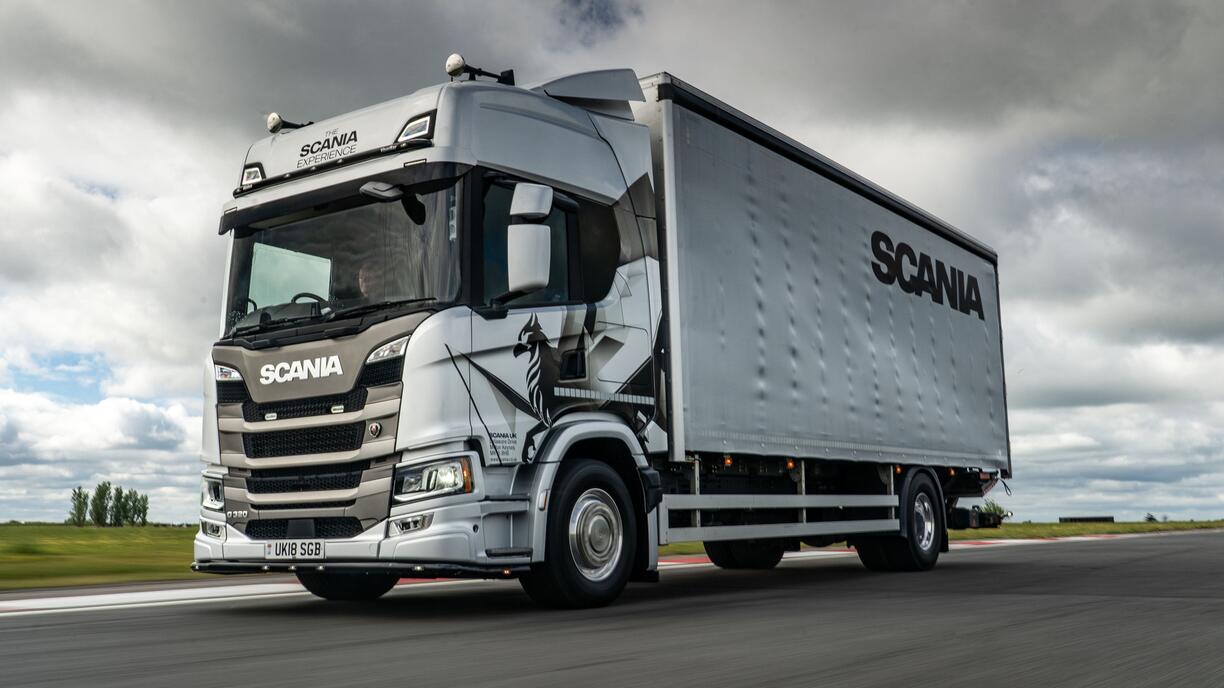
Whether it’s paired with a curtainsider, flatbed, tipper or specialist body or configured as a tractor unit, the Scania G-series cab is available in just about any conceivable specification. The G-series is Scania’s medium height option which means it’s as suited to regional distribution as it is to national haulage. It’s a great all-rounder that allows fleets to be flexible with the type of work they use the vehicle for.
Reasons to buy:
- Great all-rounder
- Wide range of engines
- Decent cabin comfort

Engines
G-series cabs can be mated to 9-litre, 13-litre, Super 11-litre and Super 13-litre engines. The range offers a huge variety of power outputs from 280 to 560hp. Scania also offers the G-series with 9 and 13-litre compressed natural gas (CNG) engines and electric powertrains. Its Super engines are designed to be the company’s most fuel efficient options, pairing power with good economy.
Expert rating: 5/5

Transmission
In keeping with its modular philosophy, Scania has an extensive gearbox range. Its standard 14-speed automated Opticruise transmission comes in G25, G33 and G38 specifications. Essentially, each version has a different torque rating, so G25 is suitable for engines up to 2500Nm of torque, G33 is rated up to 3300Nm of torque and G38 handles the top end at 3800Nm of torque. For more specialised needs, 12-speed range-splitter gearboxes are available, which can be had with two extra crawler gears for heavy haulage. Scania also offers eight-speed range-change gearboxes.
Expert rating: 5/5

Cabs
The G-series comes in three cab variants, G-short, G-day and G-sleeper, all of which have a 325mm engine tunnel. The G-short is a typical day cab option which can be fitted with a third seat in the middle on top of the engine tunnel. Scania’s G-day cab can be had with a normal or low roof and either a central seat or fold away bed. Unlike the sleeper cab which has an 80cm wide bed, the day cab bunk is 34cm wide at its narrowest point and is designed for short rest periods. Sleeper cabs can be specified with a high roof to offer up to 1.8m standing height. The G-sleeper can also accommodate an upper bunk so two drivers can work together on longer trips. As G-series cabs have a lower driving position than long-haul trucks, they don’t benefit from a flat floor which can make it more difficult to move around the cab.
Expert rating: 3/5

Comfort and storage
Drawers under the bed and under the dash provide useful spaces for a fridge or paperwork. On the passenger side, a flat surface can house a coffee machine or act as a desk space. Overhead and above the bunk, several lockers provide ample storage for personal belongings and appliances like a microwave. The adjustable fabric drivers seat is comfortable on long journeys and the leather steering wheel feels high quality. It’s moved by unlocking a button under the wheel rather than a foot button as seen with other manufacturers. This setup makes it a bit more cumbersome to move the steering wheel out of the way when the driver is quickly getting in and out of the cab. The example we tried was fitted with the old style dashboard but the G-series now comes with Scania’s digital dash which does away with some of the buttons. Climate controls are always present on the touchscreen display for easy access. Wherever you look in the cab, there’s useful cubbies and an adjustable reading light at one end of the bed.
Expert rating: 4/5

Safety
Scania has carefully integrated the latest safety features into the G-series with a mixture of audible and visual alerts. For example, automatic hill hold control has a distinct sound when it engages, so drivers don’t have to look down at the dash. The blind spot monitor uses amber and red warning lights in the A-pillar paired with an audible alert. Both rigids and tractor units are fitted with reversing cameras but Scania is yet to introduce mirror cameras. This meant its EuroNCAP safety rating was four stars out of five, as despite the good visibility offered by the lower cab height and large windows, testers felt mirror cameras would improve safety further. Scania tends to be a later adopter for new tech, so we’re expecting to see mirror cameras become available as its models are updated in the coming years.
Expert rating: 3/5

Handling
The 14-speed gearbox makes a noticeable difference compared to 12-speed transmissions as it smooths out each gear change and means the truck moves away much easier at lower speeds. The example we tried was fitted with an exhaust brake as well as an engine retarder. The retarder feels very strong and responds almost immediately, similar to Iveco’s equivalent. The large curved windscreen and low window lines give great visibility and the cab is particularly well insulated from road, engine and wind noise.
Expert rating: 4/5

Running costs
Provided the vehicle is well maintained, it should retain its value fairly well. Opting for either the Super 11 or Super 13 engines will help to maximise fuel economy and lower running costs. When the driver accelerates and decelerates, the dash often shows tips to improve fuel efficiency or praises the driver for smooth driving. Training is one of the best ways to optimise fuel use and reduce wear and tear on the brakes by showing drivers how to use the retarder most effectively.
Expert rating: 4/5

Warranties and dealer networks
While most manufacturers rely on dealer partners to operate their service network, Scania’s network is mostly owned. It has a handful of franchise partners including the likes of Keltruck, TruckEast and West Pennine Trucks. Across the UK it has more than 80 dealer points. As standard its trucks come with a 12-month warranty and various repair and maintenance packages can be configured with your local dealer.
Expert rating: 4/5

Why buy?
It’s clear to see why fleets that opt for Scania vehicles stay loyal to the brand. The G-series feels extremely comfortable and practical for regional or longer haul work. Now, the rest of the market has moved on with a technology forward approach featuring mirror cameras, in this respect it feels like Scania is lagging behind. However, its digital dashboard display is on par with competitors and every new safety feature is easy to understand with audible and visual warnings which is a huge plus for minimising driver overload, especially in mixed fleets. As always, Scania’s focus on modularity means the G-series can be specified with almost any chassis, engine or body, making it a very versatile option.
Expert rating: 4/5