Rolls-Royce Phantom saloon (2003 – ) expert review
By Craig Thomas, 30th March 2011
The verdict
The Rolls-Royce Phantom is about as special as a car can get. Quiet, refined, powerful and with a ride that supplies a close approximation of floating on air, it is the height of automotive aspiration.
Interested in this car?
Pros
- Supremely luxurious ride
- Highly refined, quiet 6.75-litre V12 engine
- Surprisingly fast for its size
Cons
- Expensive to buy
- Running costs will prove to be punitive
- High CO2 emissions
Full Review
1. Exterior
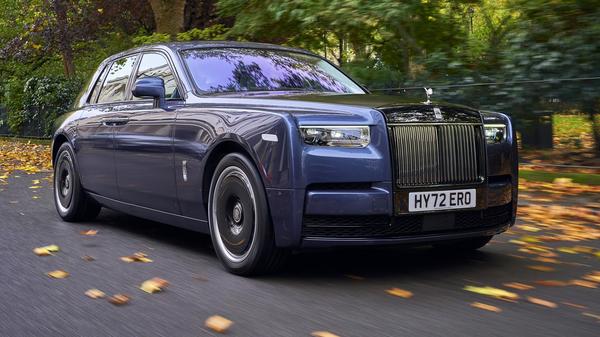
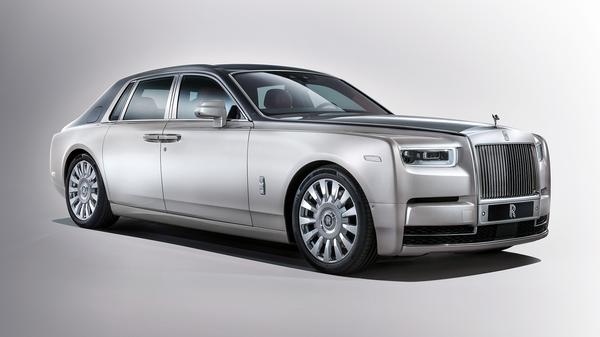
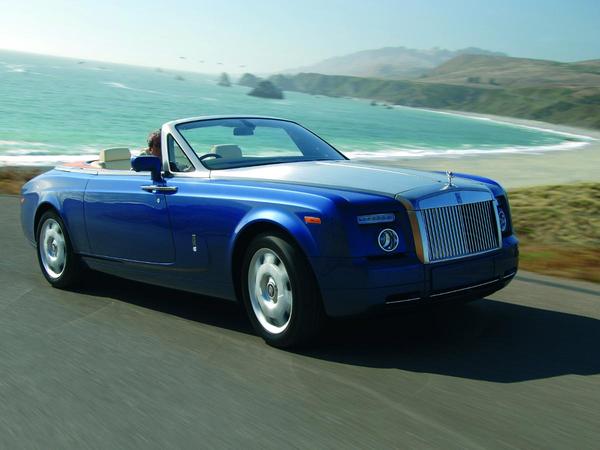
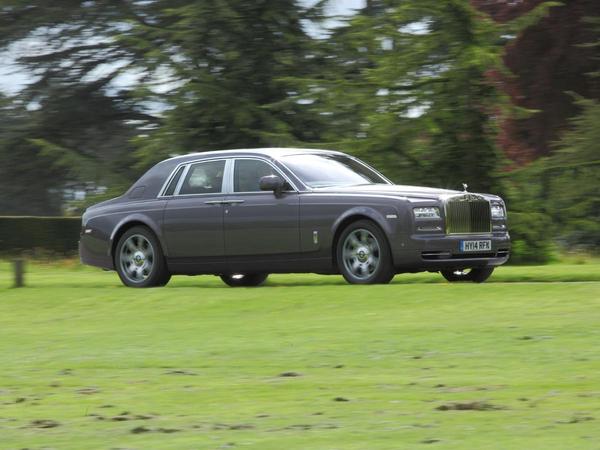
The Phantom was the first car built by Rolls-Royce after it was acquired by BMW in 1998 and was immediately a serious statement of intent. It had to be an imposing car that not only connected with the marque’s illustrious history, but also had to move that sense of heritage on into the 21st Century. And the Phantom is nothing if not imposing: at 5.834m long (6.084m if you opt for the long-wheelbase version) and 1.99m wide, it’s a big car. Unfortunately, the size has an impact on the styling, which is rather slabby and makes the Phantom look a little ungainly from some angles, although there is still an unmistakable air of elegance.
Our rating: 3
2. Interior
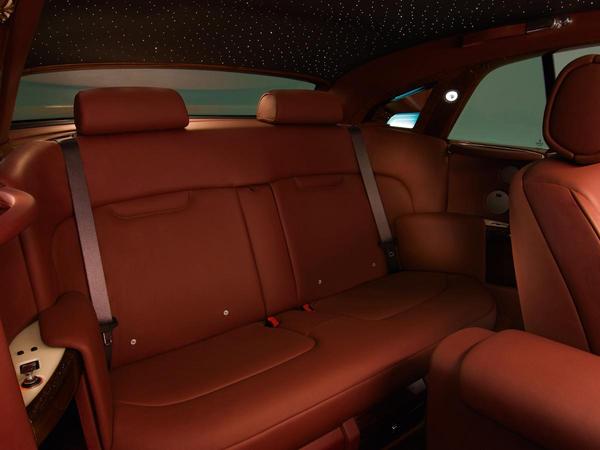
The cabin is all you’d expect of a Rolls-Royce. Depending on how the customer specs their car (and the possibilities are endless, thanks to an established bespoke programme), the interior is a haven of soft leather, cashmere, wood and metal trims, all of which exudes luxury. All the dials and switches are very classy, and the dashboard layout, while surprisingly busy, is quite logical and easy to use. The impression is one of traditional style with a contemporary update, which will appeal to those buyers for whom a Rolls-Royce’s Britishness is an important part of the package.
Our rating: 4
3. Practicality
The Phantom is a full five-seater with four doors – with the rear ones hinged at the back to make ‘suicide doors’ that open to create a very practical aperture that will allow passengers of practically all dimensions to gain access. The front seats are also very accommodating, with hugely comfortable chairs that are high enough to afford excellent forward visibility (although the view out of the back leaves a little to be desired). There’s also a cavernous 460-litre boot – on a par with the likes of the BMW 3 Series Touring – that will swallow up impressive amounts of luggage.
Our rating: 4
4. Ride and handling
A car this big can’t handle well, right? The Phantom’s size belies its ability on the road: there’s no doubt that its 2.5-tonne weight is ever-present, but it is remarkably well contained when changing direction, even at speed, thanks to a rigid aluminium spaceframe. The steering is neat and accurate, if a little light, and there is a little bit of roll, but you have to be racking up a speed not in keeping with the sedate nature of the Phantom to really experience it. And when it comes to the ride, sedate is the very word to use, the air suspension system enabling the Phantom to ride as beautifully as you’d expect a Rolls-Royce to. Almost no road surface is too broken, no pothole too deep, no hump to high to disturb the experience of riding in this supremely comfortable car.
Our rating: 4
5. Performance
Under the Phantom’s bonnet is a hand-built, naturally aspirated 6.75-litre V12 engine that produces 453bhp. Even with all this power on tap, the Phantom still has the power to surprise when attempting the 0-60mph sprint, which it manages to achieve in a mind-boggling 5.7 seconds – mind-boggling because it’s a 2.5-tonne car. It’s also incredible fun to stamp hard on the throttle and feel the surge from, initially, the torque at 1,000rpm, followed by the power further up the rev range. In normal driving conditions, the acceleration feels effortless, the smooth, refined engine oozing power as you squeeze the throttle when moving from cruising to overtaking mode and a six-speed automatic transmission also aids unruffled progress, shifting gears smoothly and seamlessly.
Our rating: 5
6. Running costs
It’s a Rolls-Royce with a V12 engine, so the Phantom isn’t going to run on the loose change in your pocket (unless you’re a Russian oligarch or member of a Middle Eastern royal family). No, an official fuel consumption of just 18mpg – which is likely to be considerably less in the real world – is likely to be crippling to anyone not raking in an investment banker-style income. CO2 emissions of 377g/km are also very high: the £435 VED won’t break the (private) bank, but hopefully some sort of environmental conscience will stimulate owners to pay in to some carbon offsetting programme. A maximum insurance group and servicing will also set buyers back a pretty penny, but if you can afford a car that costs just under £300,000, such concerns will be minimal.
Our rating: 2
7. Reliability
The Phantom doesn’t sell in sufficient numbers to show up in customer satisfaction surveys, and Rolls-Royce owners tend to be sufficiently private and discreet to not make any problems with their cars public. That said, Rolls-Royces are built by hand by highly trained and skilled craftspeople in a purpose-built facility, so it’s unlikely that there are any major problems. And when you factor in that many components tend to be supplied by parent company BMW, and are likely to be tried and tested in models such as the 7 Series, the result is a very reliable car.
Our rating: 4
8. Safety
All car occupants are equal, but the chances are that those in Rolls-Royces would consider themselves to be more equal than others, so the Phantom incorporates the very latest in safety technology. In addition to the rigid aluminium spaceframe, there are also features such as the positioning of the rear seats behind the C-pillar, which means there’s no need for side-impact airbags at the back; crumple zones that dissipate the force of a collision through the chassis; and an Intelligent Safety and Information System (ISIS) that takes readings from sensors around the car and, if the car is in an accident, makes 4,000 calculations a second to work out how bad the impact is, triggering safety measures such as the deployment of airbags and pre-tensing seatbelts if it deems necessary. The ISIS also works with active safety systems such as dynamic stability control and dynamic traction control, to avoid getting into too much trouble in the first place.
Our rating: 4
9. Equipment
The list of equipment is almost endless and depends how mad you want to go on the options list – and whether you want to even go as far as indulging in bespoke items (almost anything is possible). So, for example, the sound system, said to be built using studio-grade components, employs 15 speakers to pump out 420 watts of crisp, clear sound from a variety of sources (CD, MP3 player, radio, etc). There’s also the option of twin 12-inch monitors set in the veneered picnic tables in the rear, which are linked to an audio-visual system that includes a six-DVD changer and digital TV tuner. Owners can also have features such as refrigerators and humidors. Plus there’s the standard infotainment system you’d expect to find in a luxury car, in this case based on BMW’s iDrive.
Our rating: 5
10. Why buy?
If you have a cool £300K itching to be set free from the constraints of your bank account, this has to be one of the best ways to spend it, automotively speaking. Superb to be driven around in, and almost equally satisfying to drive yourself, the Phantom is the very pinnacle of the luxury saloon.
Our rating: 5
Expert review 4.0stars
- Exterior3
- Interior4
- Practicality4
- Ride and handling4
- Performance5
- Running costs2
- Reliability4
- Safety4
- Equipment5
- Why buy?5
The Phantom was the first car built by Rolls-Royce after it was acquired by BMW in 1998 and was immediately a serious statement of intent