A Mini adventure
29 March 2007 Its the most loved British car of all time, so it comes as no surprise the Mini has been a hit in TV, film and motorsport not to mention playing an unlikely part in breaking the world land speed record.
As it approaches its 50th birthday next year, the car will once again grace the Silver Screen in Mr Bean's
Stuart Milne takes a look at ten of the most important Minis of the last 49 years.
The Italian Job Minis and the Italian Job are so closely linked, it's impossible to think of one without the other. So
In the original film, Michael Caine leads a gang of robbers to steal a truck-load of gold from under the mafia's noses. The problem? They need to get their loot through the traffic jam-ridden streets of
Although a classic piece of fiction, the Mini would have been the perfect car for the ambitious thief to make good their getaway.
Let's face it, for sliding through gaps in traffic and even driving on the occasional tunnel wall the Mini is in a class of its own.
Can't improve on perfection, eh?
BMW managed it with the new Mini; proving all the doubters wrong. The team behind it somehow retained the original's youthful exuberance, while increasing space, comfort and safety.
It might not look exactly like the old one although the headlights, taillights and the huge centrally-mounted speedo are unmistakably Mini but it was never going to be a carbon copy. Demands for extra cabin space, bigger engines and more equipment and safety features saw to that.
But the sheer number of them rolling out of BMW's factory in
There are few more iconic rally cars the Paddy Hopkirk-era Cooper S.
Hopkirk's John Cooper-prepared Mini stormed to victory in the 1964
With Henry Liddon in the co-drivers' seat, the S scored its first of three victories in the race. It would have been four wins, but judges in the 1966 race ruled the Mini was using an illegal type of headlamp. Citroen grabbed the victory that year, but driver Pauli Toivonen vowed never to drive for the French team again.
The judges ruling did more to secure the Mini a place in the heart of the car buying public than any other moment in motorsport.
The Mini became one of the most unlikely heroes in the development of the first car to go supersonic Thrust SSC (pictured right).
Glynn Bowsher, one of the unsung heroes behind the 763mph record-breaking machine, hatched the idea of rear wheel steering to reduce the size of Thrust's front end.
But his colleagues were unconvinced, saying it would end in an upside-down mess, so Bowsher built a rear-wheel-steer Mini to prove he hadn't lost the plot.
He was right, and SSC's place in history was assured.
Pic: Andrew Graves www.andrewgraves.biz
Rowan Atkinson's first comedy series after Blackadder saw him starring alongside a character even more bonkers than Baldrick. His Mini was at the heart of many of Bean's funniest moments.
In crazy scenes worthy of Frank Spencer, Bean would remove the steering wheel from his lime green Mini to deter thieves, and lock it using a padlock. Another show saw him driving it from an armchair tied to the roof.
It gets another A-list appearance in the latest Bean flick, Mr Bean's Holiday, supplying all manner of hilarity as Atkinson's character embarks on a journey to the south of
Photography by Giles Keyte
After a decade of production, British Leyland gave the Mini a new face. The Clubman as it was known, was designed to replace the Riley Elf and Wolseley Hornet which were a couple of upmarket Minis themselves (see below).
Although
Most significantly for fans of hot Minis, the hugely successful Cooper S was replaced by the Clubman-look 1275GT (right) and became the last 'super' Mini until the 1990s when various fuel injected, wide-wheeled Coopers went on sale.
Taking craziness to the next level is the Mini Concept Tokyo, which was unveiled at the, erm, Tokyo Motor Show in 2005.
Although it had a serious reason to be there (to see if there would be enough interest in a new Countryman estate model), it was the weird and wonderful bits inside and out which got showgoers twitching.
The Concept Tokyo has Union Flag stickers and a roof lining inspired by Brit designer Paul Smith. A storage space in the boot houses a table and chairs, while a box housing the all-important picnic set is attached to the rear side window.
The Elf and Hornet don't look much like Minis, but almost 60,000 buyers thought them sensible and stylish enough to part with their hard-earned for one.
By the second half of the last century, many smaller British car marques had merged into conglomerates which eventually came together to form British Leyland.
Having a huge portfolio of brands meant the same car could be subtly restyled, have a different badge slapped on and make an even bigger profit for the company.
Both the Riley and Wolseley were handsome cars, evoking memories of sporty and luxury cars of a bygone era. Of course, they benefited from the Mini's natural talent, and remain one of the most criminally overlooked of all Minis.
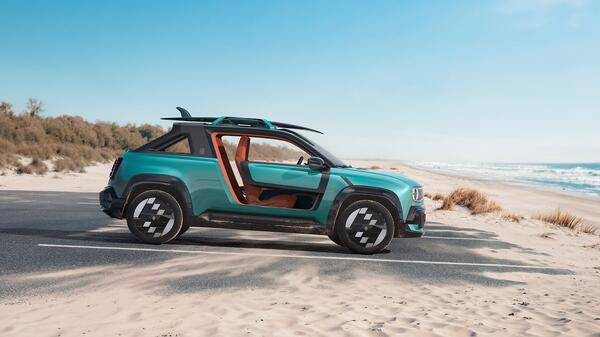
Incredibly the Mini Moke was originally developed as a low-cost small military vehicle; but its total lack of ground clearance and four wheel drive made it hopeless on the rough stuff.
It finally found its niche as a beach buggy and an official form of police transport in
Despite production numbers in the low 100,000s, BMW is rumoured to be planning a new Moke in the next few years.
The new Mini is famous for the number of options buyers have to make their new car stand out from the crowd. Countless combinations of colours, stripes, alloy wheels and spoilers can be had for a relatively small price.
But the ultimate has to be the Union Flag roof. Its a British success story which is built in |
Page 1

New Mini
Monte Carlo
Thrust SSC development vehicle
Mr Bean's Mini 1000
Mini Clubman
Mini Concept
Riley Elf & Wolseley Hornet
Mini Moke
Union